Inflation and salaries are back at the top of the agenda just as compensation teams close their 2027 budgets. Euro area inflation jumped to 3.8% in September 2026, according to Eurostat’s flash estimate, up from 3.2% in August and 2.0% a year earlier, driven by an energy shock linked to the conflict in the Middle East (Eurostat, 2026a, 2026b). Pay growth, meanwhile, is running at around 3%.
The question for HR directors and Total Rewards leads is not only whether the company can afford more, but whether a typical 2–3% raise protects people’s purchasing power at all, and what to do if it does not. Most European employees have still not recovered what they lost after 2021, so a new round of real-wage cuts arrives on top of an old one.
This guide combines the latest Eurostat, ECB and OECD data with TalentUp job-posting data to answer three questions: how much purchasing power has been lost by country, is a 3% raise enough for 2027, and how should you build and communicate a 2027 salary budget in a period of rising prices.
Key takeaways
- Euro area inflation reached 3.8% in September 2026; Spain (5.0%), Belgium (4.6%) and Italy (4.1%) are well above the average.
- Over 2021–2025, euro area prices rose 22.6% and hourly wages 19.2%: real wages are still about 2.8% below their 2020 level, and 8.6% below in Italy.
- At September rates, a 3% raise is a real pay cut in every large euro area economy except the Netherlands; against the ECB’s 2.5% forecast for 2027, it is a small real gain.
- Very few employers promise inflation protection in job ads: fewer than 1 in 1,000 postings in Germany and the UK in 2026, according to TalentUp data.
- Build the 2027 budget in separate pools (mandatory, cost of living, merit, market adjustment) and document the criteria behind each, which pay transparency rules will require as national laws apply.
Inflation and salaries in 2026: the latest data
The rebound is uneven. In Eurostat’s September 2026 flash estimate, annual inflation reached 5.0% in Spain, 4.6% in Belgium and 4.1% in Italy, while France (3.4%), Germany (3.3%) and the Netherlands (3.0%) were closer to 3% (Eurostat, 2026b). In August, rates across the whole EU ranged from 0.3% in Sweden to 6.3% in Romania (Eurostat, 2026a).
What drives inflation matters for HR. Energy prices rose 18.8% year on year in September, while services inflation edged up to 3.2% (Eurostat, 2026b). Energy shocks tend to fade; services inflation is closely tied to wages and tends to last longer. The ECB projects headline inflation of 3.0% in 2026, 2.5% in 2027 and 2.1% in 2028, with a peak of 3.6% in the fourth quarter of 2026, and core inflation (excluding energy and food) of 2.6% in 2027 (ECB, 2026a). Those projections were finalised before September’s jump to 3.8%.
Wages, so far, have not reacted. Compensation per employee grew 3.3% in the second quarter of 2026, down from 3.5% in the first, and the ECB notes that wages have “not shown a material response to the energy shock so far” (ECB, 2026b). Hourly labour costs rose 3.1% in the euro area, with wages and salaries up 3.0% (Eurostat, 2026c). The ECB wage tracker points to negotiated wage growth of 2.7% in the first half of 2027 (ECB, 2026c).
| Indicator (euro area) |
Latest figure |
Period |
Source |
| Annual inflation (HICP) |
3.8% |
September 2026 (flash) |
Eurostat |
| Energy inflation |
18.8% |
September 2026 (flash) |
Eurostat |
| Compensation per employee |
3.3% |
Q2 2026 |
ECB |
| Hourly wages and salaries |
3.0% |
Q2 2026 |
Eurostat |
| Negotiated wages (wage tracker) |
2.7% |
H1 2027 |
ECB |
| Inflation forecast |
2.5% |
2027 |
ECB, September 2026 |
With inflation near 4% and pay growth at or below 3%, real wages are falling again.
Real wages in Europe since 2021: who lost purchasing power?
To understand how employees will react to the new price surge, look back first. Over 2021–2025, consumer prices in the euro area rose by 22.6% while hourly wages rose by 19.2%, leaving the average employee with roughly 2.8% less purchasing power than in 2020, according to our calculations based on Eurostat data (Eurostat, 2026d, 2026e).
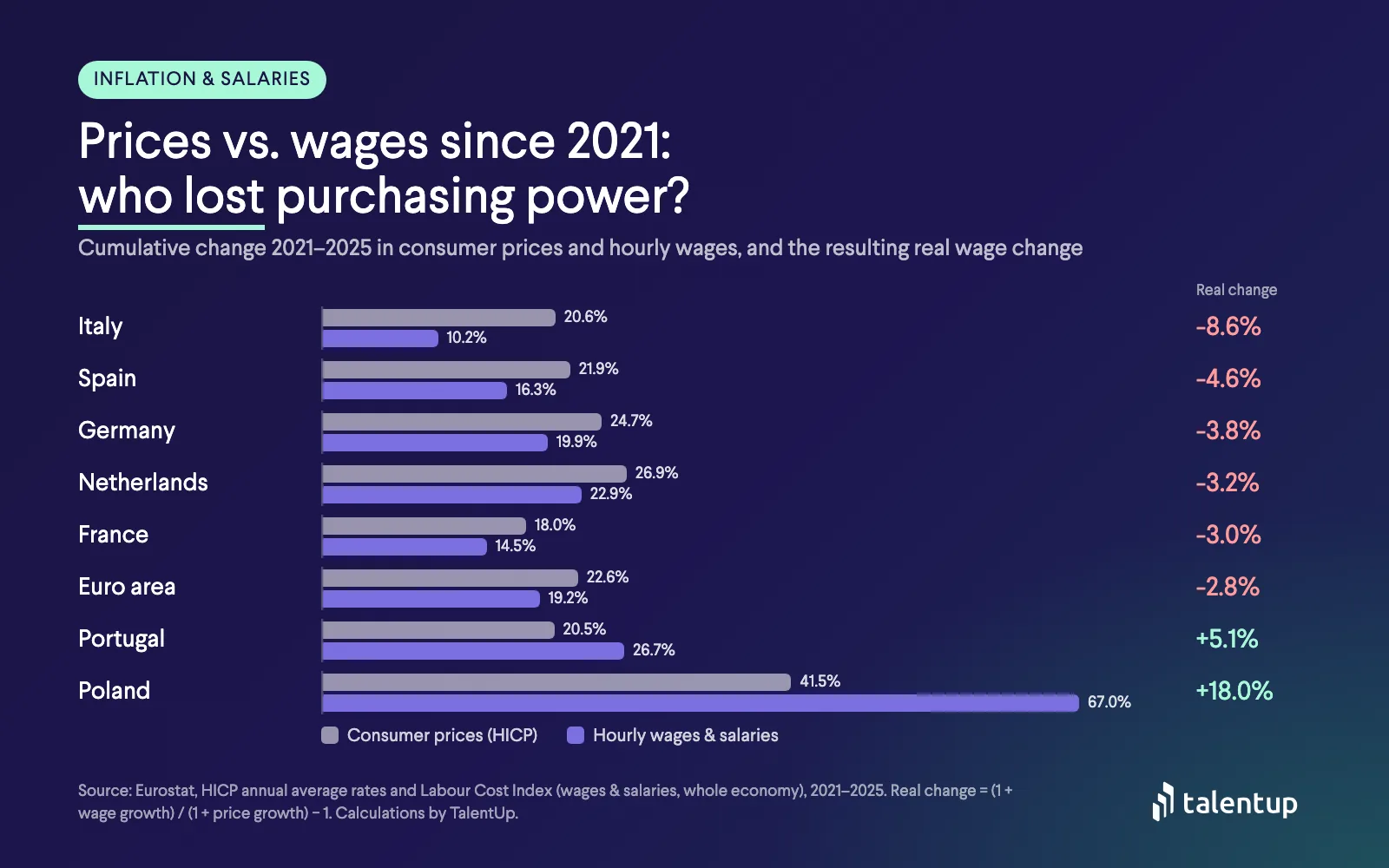
Cumulative change in consumer prices (HICP) and hourly wages and salaries (Labour Cost Index), 2020 annual average to 2025 annual average. Source: Eurostat; calculations by TalentUp.
| Country |
Consumer prices 2021–2025 |
Hourly wages 2021–2025 |
Real wage change |
Raise needed to recover 2020 level |
| Italy |
+20.6% |
+10.2% |
−8.6% |
+9.4% |
| Spain |
+21.9% |
+16.3% |
−4.6% |
+4.8% |
| Germany |
+24.7% |
+19.9% |
−3.8% |
+4.0% |
| Netherlands |
+26.9% |
+22.9% |
−3.2% |
+3.3% |
| France |
+18.0% |
+14.5% |
−3.0% |
+3.1% |
| Euro area |
+22.6% |
+19.2% |
−2.8% |
+2.9% |
| Portugal |
+20.5% |
+26.7% |
+5.1% |
— |
| Poland |
+41.5% |
+67.0% |
+18.0% |
— |
Source: Eurostat HICP and Labour Cost Index; calculations by TalentUp. “Raise needed” is the real increase, on top of future inflation, that would restore 2020 purchasing power.
The OECD reaches a similar conclusion: in the third quarter of 2025, real wages were still below their early-2021 level in half (19) of the 37 OECD countries analysed, and more than 2% below in a quarter of them, including Italy and Spain (OECD, 2026).
This history shapes expectations. People who have already lost ground are more sensitive to a new rise in prices: a raise that would have felt fair in a low-inflation year can now feel like a pay cut, which drives disengagement and attrition among exactly the high performers who have options in the market.
Is a 3% raise enough in 2027?
As we explained in our analysis of salary increase budgets for 2027, most Western European companies are planning increases of 2–3%. Whether 3% is “enough” depends on which inflation figure you compare it with.
Practitioners see the same pattern. Ludovic Wolff, who leads the Rewards, Benefits & Share Plan practice at Alixio Group, summarised a survey of nearly 100 HR and C&B directors of large French companies:
 Ludovic WolffRewards, Benefits & Share Plan Practice Leader, Alixio Group
Salary review budgets are rising again (2.3% for 2027, after 1.9% actually awarded in 2026) BUT in a volatile context: expected inflation for 2027 ranges between 1.8% and 2.2% depending on the institute, because it depends heavily on the situation in the Middle East.
A more individualised pay policy: fewer general increases (almost gone for managers), while individual increases and promotion budgets are growing.
Looking back (current inflation). At September 2026 rates, a 3% raise is a real cut in every large euro area economy except the Netherlands, where it breaks even:
| Country |
Inflation, Sept 2026 |
Real value of a 3% raise |
On a €40,000 salary |
| Spain |
5.0% |
−2.0 pp |
−€800 |
| Belgium |
4.6% |
−1.6 pp |
−€640 |
| Italy |
4.1% |
−1.1 pp |
−€440 |
| Euro area |
3.8% |
−0.8 pp |
−€320 |
| Portugal |
3.6% |
−0.6 pp |
−€240 |
| France |
3.4% |
−0.4 pp |
−€160 |
| Germany |
3.3% |
−0.3 pp |
−€120 |
| Netherlands |
3.0% |
0.0 pp |
€0 |
Source: Eurostat flash estimate, September 2026 (Eurostat, 2026b); calculations by TalentUp. The euro column compares a €1,200 raise with the extra cost of the same basket at current inflation; it ignores taxes and individual consumption patterns. In Belgium, automatic indexation closes much of this gap by law (see below).
Looking forward (expected inflation). A raise paid in 2027 is spent at 2027 prices. If the ECB is right and inflation averages 2.5% in 2027, a 3% increase is a modest real gain. But that forecast predates September’s jump, and it does nothing for the 3–9% that employees in Italy, Spain, Germany, the Netherlands and France have already lost since 2020.
The practical reading: 3% is enough to avoid a further real cut only if inflation falls as projected, and it does not repair past losses. Where you sit on that spectrum should depend on your workforce’s exposure, your market position and your retention risk, not on a single headline number.
The August data, published before the flash estimate, showed the same pattern at lower levels:
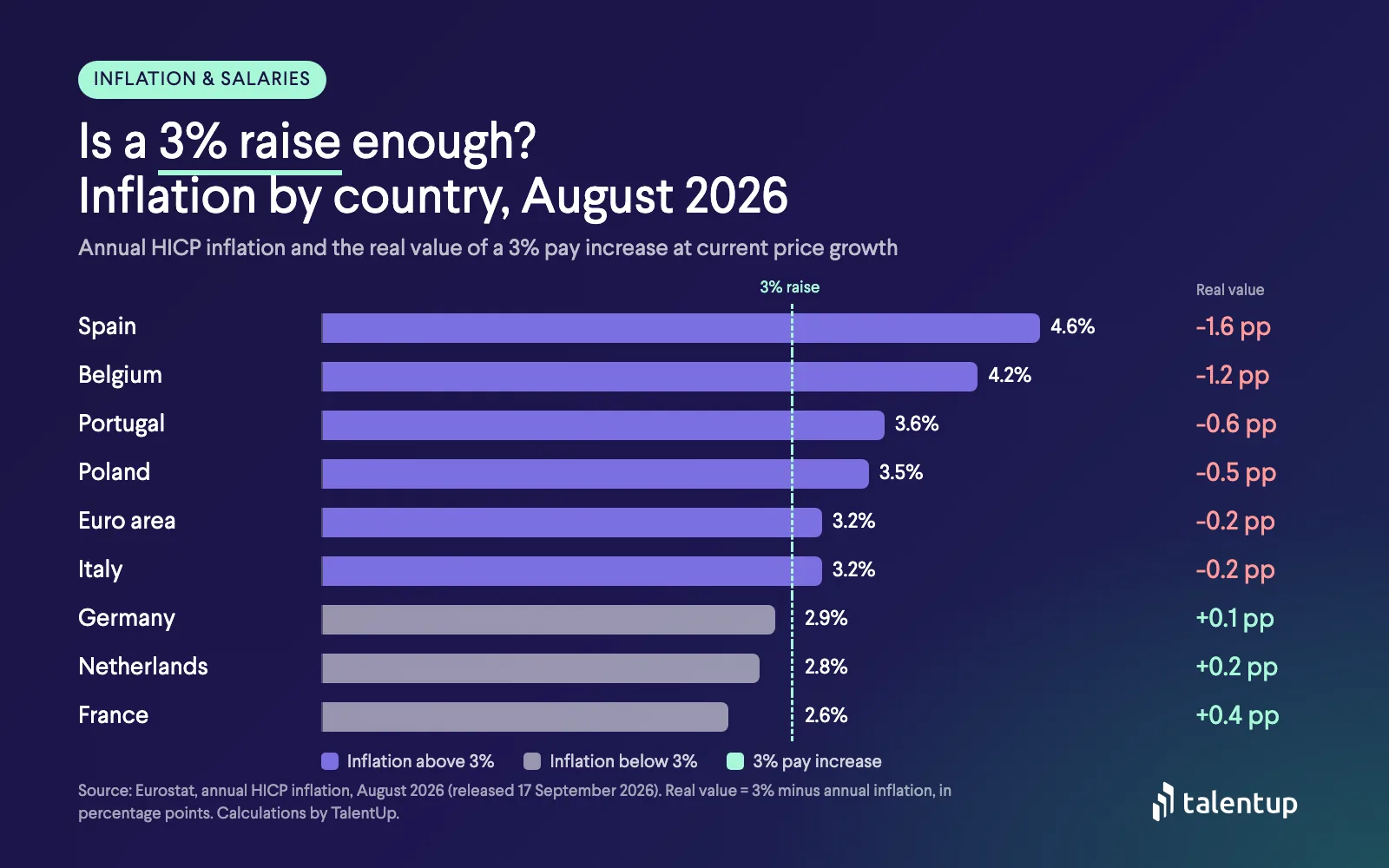
Annual HICP inflation in August 2026 against a 3% pay increase. Source: Eurostat (released 17 September 2026); calculations by TalentUp.
Should salaries be linked to inflation?
When prices rise, employees and works councils ask for raises that match inflation. There are good arguments on both sides, and most European employers end up with a hybrid.
|
Automatic inflation matching |
Market- and merit-based pay with targeted protection |
| Cost |
Turns a temporary price shock into a permanent rise in the salary base, pensions and every future percentage raise |
Permanent cost only where the market or performance justifies it; temporary support can be one-off |
| Performance link |
Weak: everyone gets the same increase |
Strong: merit and market adjustments stay differentiated |
| Fairness |
Same percentage for all, even though inflation hits lower earners harder |
Can be targeted at lower bands and the most exposed roles |
| Retention |
Protects everyone’s purchasing power |
Protects critical and at-risk roles first |
| Predictability |
Low: cost depends on an index you do not control |
High: you set the pools in advance |
The underlying principle is simple: base pay follows the cost of labour, not the cost of living. Inflation tells you what has happened to prices; it does not tell you what competitors pay for a role. A role can be well paid against the market even after losing ground to inflation, and vice versa. That is why the most robust approach is to separate the inflation response from merit and anchor individual decisions in market data, as we explain in our guide to balancing internal equity and market competitiveness.
Compensation consultants make the same point. Commenting on Kienbaum’s 2027 salary forecast for Switzerland, Timon Forrer put it this way:
 Timon ForrerCompensation & Rewards Consultant, Kienbaum (Zurich)
While the unions are demanding 2.5% more pay for everyone, Swiss companies are currently planning around 1.1% on average – a real-terms increase given the forecast 0.6% inflation. […] Put simply, the central question is: how much do we have to, want to and can we pay to keep the right people? Inflation certainly plays a role – but it is only one factor among several.
What employers actually promise: TalentUp data
If inflation-linked pay were common practice, it would show up in job ads, where employers advertise their pay policies. It barely does.
0.7 per 1,000
job ads in Germany mentioned inflation compensation in 2026, down from 1.6 in 2024
0.2 per 1,000
UK job ads promised cost-of-living or inflation-linked rises in 2026, down from 0.4 in 2024
3 ads out of ~695,000
in Spain mentioned a CPI-linked salary review in 2026
Source: TalentUp job postings database, January–September of each year. See methodology below.
The German drop matches the end of the tax-free Inflationsausgleichsprämie (up to €3,000 free of tax and social security contributions, available until 31 December 2024), which many 2024 ads listed as a benefit (Handwerksblatt, 2024). In the UK, the remaining mentions typically promise “a pay rise in line with inflation” or an annual cost-of-living review. The signal is clear: inflation protection is almost never a selling point in hiring. Employers compete on salary levels, not on indexation promises, which is another reason to fix inflation responses inside the internal budget rather than in offer letters.
Wage indexation in Europe: what is mandatory?
Before you set a merit budget, quantify the increases you are obliged to pay. Higher inflation makes these obligations larger than planned.
| Country |
Main mechanism |
What it means for 2027 |
| Belgium |
Automatic indexation set by each joint committee. For example, joint committee 200 (white-collar employees) indexes salaries every 1 January; others index when prices rise by 2% |
Indexation will absorb most of the inflation gap, at a cost to the employer. A 2026 reform caps the first 2% of indexation at the first €4,000 of gross monthly salary from 1 June 2026, with a second moderation period from 1 January 2028; employers pay 50% of the saving as social contributions (DLA Piper, 2026) |
| Spain |
Sector and company collective agreements (convenios colectivos), many with salary revision clauses (cláusulas de revisión salarial) linked to the CPI. The V AENC framework recommended 4% (2023), 3% (2024) and 3% (2025), plus up to 1% extra if December CPI exceeded the agreed increase (Garrigues, 2023) |
Check every applicable convenio for revision clauses triggered by 2026 inflation. The VI AENC (2026–2028) had not been signed as of late June 2026; unions proposed 4% a year and a 1.5% revision clause (CCOO & UGT, 2026; Qué!, 2026) |
| Germany |
Sector collective agreements (Tarifverträge), no automatic indexation |
Pay rises are negotiated; one-off inflation payments were used in 2022–2024 |
| Netherlands |
Sector collective agreements (cao), some with price compensation clauses |
Check your cao for automatic price compensation |
| France, Italy |
Sector agreements and statutory minimum wage updates; no general indexation of salaries |
Minimum wage and sector minimum updates push up pay floors |
Statutory minimum wages matter everywhere. The OECD finds that minimum wages have risen more than median wages since 2021, compressing the bottom of the pay distribution (OECD, 2026). If entry-level pay keeps rising faster than the rest, the gap between junior and experienced employees narrows, and experienced staff may feel undervalued.
How to build a 2027 salary budget in a period of inflation
A single “3% for everyone” budget no longer works. Split it into pools with different rules:
| Pool |
Purpose |
Who gets it |
Typical design |
| 1. Mandatory |
Indexation, collective agreements, minimum wage changes |
Everyone covered |
Fixed by law or agreement: model it under two or three inflation scenarios |
| 2. Cost of living |
Protect purchasing power where it hurts most |
Lower bands and the most exposed countries |
Flat euro amount or tiered percentage; one-off if the shock looks temporary |
| 3. Merit |
Reward performance |
Differentiated by rating |
Matrix by performance and position in band |
| 4. Market adjustment |
Fix roles paid below market |
Critical and hard-to-hire roles below range |
Driven by current benchmarks, not by the inflation index |
| 5. Promotion |
Recognise moves to a higher level |
Promoted employees |
Usually managed separately from the review |
How to size each pool:
- Start with the mandatory pool. Calculate the cost of indexation and collective agreements at the current inflation rate and at a higher scenario (for example, September’s 3.8% persisting into early 2027). Whatever remains is your discretionary budget.
- Map exposure. Measure the real wage change for your own workforce since 2020, by country and salary band, using the table above as a reference. Lower-paid employees spend a larger share of income on energy and food, so they feel inflation most.
- Decide between permanent and one-off support. If you expect inflation to fall back towards the ECB’s 2.5% in 2027, a one-off cost-of-living payment protects employees without raising the salary base permanently. Check the tax treatment in each country first.
- Protect the merit pool. If cost of living absorbs the whole budget, top performers get the same as everyone else. Many employers keep merit and market adjustments at a fixed share of the budget and fund cost-of-living support separately.
- Prioritise market gaps. Use current market data to find roles that are both below market and in high demand: that is where the risk of losing people is greatest. Our step-by-step salary benchmarking guide explains how to do it.
- Check compression. After modelling, review the distance between grades and each employee’s position in their band, so flat-euro increases for lower bands do not erase meaningful differences between levels.
- Use the rest of the package. Meal and transport allowances, childcare support and flexible benefit plans can raise net income at a lower cost than an equivalent gross raise, depending on local tax rules. Variable pay is another lever: see our guides to bonus structures, bonus timing and long-term incentives.
How to communicate real-wage changes
Employees know what is happening to prices. How you explain the 2027 review matters almost as much as the numbers.
- Do not oversell. Presenting a 3% raise as generous when inflation is near 4% damages trust. Acknowledge the gap.
- Explain how the budget was built: the mandatory, cost-of-living, merit and market pools, and why each exists.
- Separate the messages. Tell employees what part of their increase responds to the cost of living and what part reflects performance or market position.
- Show the whole package. A total reward statement helps people see the value of benefits, variable pay and pension contributions alongside base pay.
- Prepare managers. Give them talking points, the criteria behind each decision and the data they need to answer “why didn’t my raise match inflation?”.
Pay transparency: why your 2027 decisions need documented criteria
The EU Pay Transparency Directive (Directive (EU) 2023/970) had a transposition deadline of 7 June 2026, and its obligations apply through national laws as each member state transposes it. Once they apply, employers must use objective, gender-neutral criteria to set pay and pay progression, make those criteria accessible to employees and, in a dispute, the burden of proof shifts to the employer (European Parliament & Council of the European Union, 2023).
Reporting on the gender pay gap starts on 7 June 2027 for employers with 250 or more workers (annually) and with 150–249 workers (every three years), and on 7 June 2031 for those with 100–149 workers (every three years). If a report shows an unexplained gap of 5% or more in a category of workers that is not remedied within six months, a joint pay assessment with workers’ representatives is required.
For the 2027 review, this means every cost-of-living, merit and market adjustment needs a documented, consistent rule. A flat euro increase for lower bands, for example, is easy to justify; ad hoc exceptions are not. If you have not yet checked how ready your pay structure is, our guide to the 2026 EU pay transparency law and the free pay transparency check are good starting points.
The bottom line: a checklist for C&B teams
- Measure the real wage gap for your workforce since 2020, by country and salary band.
- Model the mandatory pool (indexation, collective agreements, minimum wages) under several inflation scenarios.
- Split the budget into mandatory, cost-of-living, merit, market-adjustment and promotion pools.
- Choose permanent or one-off support based on how persistent you expect inflation to be.
- Protect lower earners with tiered or flat-euro increases, and check pay compression afterwards.
- Benchmark critical roles against current market data before final decisions.
- Document the criteria for every adjustment, in line with pay transparency rules as they apply.
- Prepare managers and employee communication, including total reward statements.
Inflation and salaries have become a strategic issue again. Most European employees have not recovered the purchasing power they lost after 2021, and a new rise in prices arrives just as companies plan cautious 2–3% budgets. The answer is not to match inflation automatically, but to understand where your people stand against both prices and the market, protect those most exposed, keep a real merit pool and explain every decision clearly.
Want to know where your salaries stand? The TalentUp Salary Benchmarking Platform gives you current salary benchmarks by role, seniority, company size and city across Europe, so your inflation response is based on today’s market, not last year’s survey. See our methodology for how the data is built.
Sources
- TalentUp. (2026). TalentUp job postings database, January–September 2024 and 2026 [Data set]. https://talentup.io/insights/
- CCOO & UGT. (2026). VI Acuerdo para el Empleo y la Negociación Colectiva (VI AENC): propuesta sindical. https://www.ccoo.es/5c29c4f6914d53a229a89bc39ace60ef000001.pdf
- DLA Piper. (2026, July 2). Belgium introduces major reforms to automatic wage indexation. https://knowledge.dlapiper.com/dlapiperknowledge/globalemploymentlatestdevelopments/2026/belgium-introduces-major-reforms-to-automatic-wage-indexation
- European Central Bank. (2026a, September). ECB staff macroeconomic projections for the euro area, September 2026. https://www.ecb.europa.eu/press/projections/html/ecb.projections202609_ecbstaff~8e340fc69d.en.html
- European Central Bank. (2026b). Economic Bulletin, Issue 6, 2026. https://www.ecb.europa.eu/press/economic-bulletin/html/eb202606.en.html
- European Central Bank. (2026c, September 16). ECB wage tracker at 2.7% in H1 2027, pointing to a modest uptick in negotiated wage growth [Press release]. https://www.ecb.europa.eu/press/pr/date/2026/html/ecb.pr260916~7bc58ebef4.en.html
- European Parliament & Council of the European Union. (2023). Directive (EU) 2023/970 to strengthen the application of the principle of equal pay for equal work or work of equal value between men and women through pay transparency and enforcement mechanisms. Official Journal of the European Union, L 132, 21–44. https://eur-lex.europa.eu/eli/dir/2023/970/oj
- Eurostat. (2026a, September 17). Annual inflation up to 3.2% in the euro area [Euro indicators]. https://ec.europa.eu/eurostat/en/web/products-euro-indicators/w/2-17092026-ap
- Eurostat. (2026b, October 2). Euro area annual inflation up to 3.8% [Flash estimate, euro indicators]. https://ec.europa.eu/eurostat/web/products-euro-indicators/w/2-02102026-ap
- Eurostat. (2026c, September 16). Annual increase in labour costs at 3.1% in euro area [Euro indicators]. https://ec.europa.eu/eurostat/web/products-euro-indicators/w/3-16092026-bp
- Eurostat. (2026d). HICP – annual data (average index and rate of change) (prc_hicp_aind) [Data set]. https://ec.europa.eu/eurostat/databrowser/view/prc_hicp_aind/default/table
- Eurostat. (2026e). Labour cost index by NACE Rev. 2 activity – annual data (lc_lci_r2_a) [Data set]. https://ec.europa.eu/eurostat/databrowser/view/lc_lci_r2_a/default/table
- Garrigues. (2023). Se publica el V Acuerdo para el Empleo y la Negociación Colectiva (V AENC). https://www.garrigues.com/es_ES/noticia/publica-v-acuerdo-empleo-negociacion-colectiva-v-aenc
- Handwerksblatt. (2024). Inflationsausgleichsprämie: 3.000 Euro steuerfrei bis Ende 2024. https://www.handwerksblatt.de/betriebsfuehrung/inflationsausgleichspraemie-3000-euro-steuerfrei-bis-ende-2024
- OECD. (2026). The real wage recovery is slowing down: The OECD wage bulletin. OECD Publishing. https://www.oecd.org/content/dam/oecd/en/publications/reports/2026/03/the-real-wage-recovery-is-slowing-down_680b8b36/507d3cf8-en.pdf
- Qué!. (2026, June 23). Bloqueo por la renovación del AENC: CC.OO. amenaza con huelgas si no hay acuerdo salarial para 2026. https://www.que.es/2026/06/23/aenc-bloqueo-patronal-movilizaciones/