The AI pay premium is the extra salary employers pay for artificial intelligence skills, and in Europe it is worth about a quarter of a software developer’s salary for an AI engineer: TalentUp salary benchmarks put the average premium at +24.8% across seven countries, from +14% in Spain to +40% in the Netherlands. But the number depends heavily on the country, the role and how you measure it. In 2026 job ads, the same comparison ranges from +5% in the United States to +30% in the United Kingdom, while some “AI” titles pay no premium at all.
That matters because salary budgets for 2027 are tight, and the AI premium is one of the few places where companies are still paying well above the market rate. For compensation and benefits (C&B) teams, the questions are concrete: how big is the premium in each market, which roles really deserve it, and how do you pay it without breaking your salary structure or your pay transparency obligations?
This guide combines TalentUp’s salary benchmarks with an analysis of 26,400 salaried job ads from 2026 in Europe, the US and Canada, explains why published figures range from 5% to 62%, and sets out a practical framework for pricing AI roles.
Key takeaways
- TalentUp benchmarks put AI engineers 24.8% above software developers across seven European countries, and the premium holds at senior level.
- In 2026 job ads the premium is largest in the UK (+30.3%) and small in North America (+5.1% in the US, +8.8% in Canada), where software engineers are already highly paid.
- Skills matter more than titles: data scientists earn less than software engineers in most markets, while US software engineer ads that ask for AI skills pay 6.3% more.
- Headline figures such as PwC’s 62% measure something different: AI skills across all occupations, not one AI role against a strong technical benchmark.
- Price AI roles by skills, fund the premium from a dedicated pool, review it every year and document it for pay transparency.
Why AI Skills Command a Premium
The premium is a classic case of demand growing faster than supply. On the demand side, AI adoption in European companies is accelerating: in 2025, 19.95% of EU enterprises with ten or more employees used AI technologies, up 6.47 percentage points in a single year, and the share reached 55.03% among large enterprises (Eurostat, 2025b).
On the supply side, Europe was already short of technical talent before the AI boom. In 2023, 57.5% of EU enterprises that recruited or tried to recruit ICT specialists had difficulties filling those vacancies (Eurostat, 2025a). AI expertise is a narrow, fast-moving subset of those skills, and experienced profiles are scarcer still.
TalentUp’s job-ad data shows how fast employer demand is moving. In seven large European markets, AI-titled ads rose from about 10 to 32 for every 100 software engineer ads between 2024 and 2026, as we show in our guide to pay ranges for emerging roles. AI engineers were also the fastest-rising role in our ranking of the most in-demand IT jobs in 2026, with their share of IT ads more than doubling in a year.
The AI Pay Premium in Europe: TalentUp Benchmark Data
To measure the premium, we compared the median base salary for AI-related roles in the TalentUp Salary Benchmarking Platform with the median for a Software Developer in the same country. This gives a like-for-like view of what employers pay on top of an already strong technical profile for AI-specific expertise.
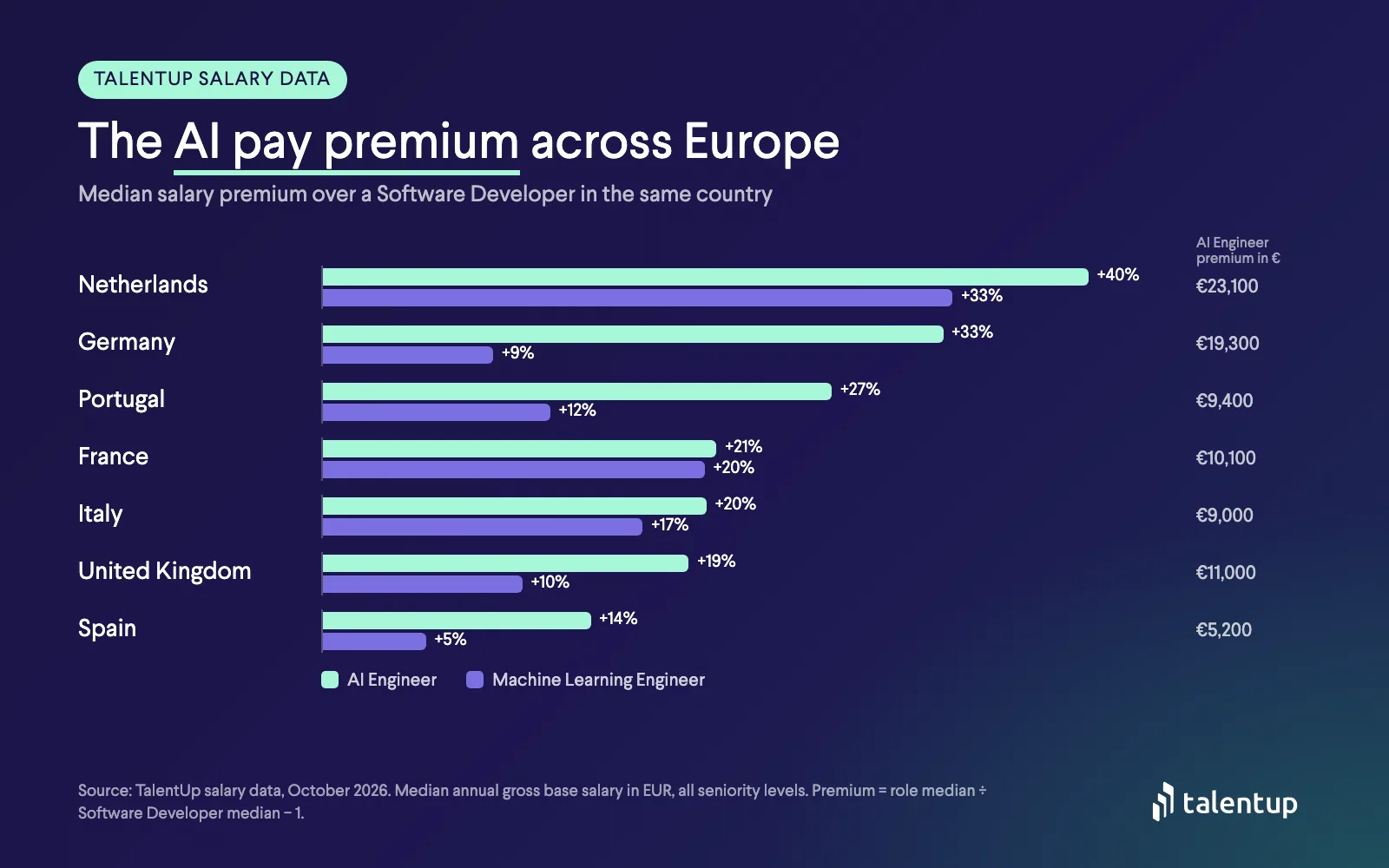
The AI pay premium across Europe. Source: TalentUp salary benchmarks, October 2026.
Across the seven countries, an AI Engineer earns on average 24.8% more than a Software Developer. The premium ranges from +40% in the Netherlands and +33% in Germany to +14% in Spain. In absolute terms, the gap is widest where salaries are highest: about €23,100 a year in the Netherlands and €19,300 in Germany, compared with €5,200 in Spain.
| Country |
Software Developer median |
AI Engineer median |
AI Engineer premium |
ML Engineer premium |
| Netherlands |
€57,500 |
€80,600 |
+40.2% |
+33.0% |
| Germany |
€59,300 |
€78,600 |
+32.5% |
+8.9% |
| Portugal |
€35,200 |
€44,600 |
+26.7% |
+11.9% |
| France |
€48,900 |
€59,000 |
+20.7% |
+20.0% |
| Italy |
€44,700 |
€53,700 |
+20.1% |
+16.8% |
| United Kingdom |
€57,300 |
€68,300 |
+19.2% |
+10.5% |
| Spain |
€37,000 |
€42,200 |
+14.1% |
+5.4% |
Source: TalentUp Salary Benchmarking Platform, October 2026. Median annual gross base salary in EUR, all seniority levels.
The Premium Holds at Senior Level
The premium is not just an effect of AI roles being more senior on average. Comparing senior AI Engineers with senior Software Developers, the gap remains large: +39.7% in the Netherlands (€26,300), +29.6% in Germany (€20,600), +26.0% in Portugal, +19.4% in France, +18.7% in the United Kingdom, +17.8% in Italy and +13.8% in Spain.
In most countries the premium is broadly similar across seniority levels. Spain is the exception: it more than doubles from +6.6% at junior level to +14.9% at lead level, a sign that in the Spanish market, experience in AI is what is truly scarce.
What Job Ads Show: Europe vs the US and Canada
Benchmarks tell you what the market pays; job ads tell you what employers are offering right now to attract new hires. Because TalentUp collects job ads worldwide, we can also compare Europe with North America using the same method.
+30.3%
AI engineering ads vs software engineer ads in the UK (n = 90 vs 810)
+5.1%
the same premium in the US (n = 1,689 vs 12,582)
+6.3%
US software engineer ads asking for AI skills vs those that do not (n = 2,367 vs 7,932)
23%
of US software engineer ads ask for AI skills
Source: TalentUp job postings database, January–September 2026. Medians of advertised salaries, see methodology below.
| Country |
Software engineer (median, n) |
AI engineering roles |
ML engineer |
Data scientist |
| United States |
$184,600 (12,582) |
$194,000 (1,689), +5.1% |
$221,400 (636), +19.9% |
$173,000 (1,389), −6.3% |
| Canada |
C$154,000 (1,866) |
C$167,500 (349), +8.8% |
C$157,500 (103), +2.3% |
C$132,600 (87), −13.9% |
| United Kingdom |
£61,100 (810) |
£79,600 (90), +30.3% |
n < 40 |
£63,800 (74), +4.5% |
| Spain |
€48,500 (249) |
€55,000 (53), +13.4% |
n < 40 |
€42,500 (63), −12.4% |
| Poland |
PLN 258,000 (781) |
PLN 282,000 (312), +9.3% |
PLN 282,000 (74), +9.3% |
PLN 270,900 (87), +5.0% |
| Netherlands |
€66,000 (333) |
€70,800 (49), +7.3% |
n < 40 |
€70,800 (41), +7.3% |
| Italy |
€45,000 (209) |
€48,000 (79), +6.7% |
n < 40 |
n < 40 |
Median advertised annual gross salary in local currency, all seniority levels; percentages are the premium over software engineer ads in the same country. Cells with fewer than 40 ads are not shown.
Three patterns stand out:
- The premium is largest where software pay is moderate. In the US and Canada, software engineers are already among the best-paid professionals, and AI engineering ads add only 5–9%. In the UK, AI ads offer almost a third more. In the US, the clearest title premium goes to machine learning engineers (+19.9%), a role concentrated in large technology employers.
- Seniority changes the picture. In the US, mid-level AI ads were advertised at the same level as mid-level software engineers (−0.4%), and senior ads only 4.1% higher. In Poland, the premium was +17.2% at mid level but +2.1% at senior level, and in Spain mid-level AI ads were 21.1% above software engineers.
- Data scientists are not paid as AI specialists. They are advertised below software engineers in the US, Canada and Spain, and in France (€50,000, n = 42, vs €60,000), confirming the benchmark finding below.
Skills, Not Titles: Which AI Roles Really Pay More
One of the most important findings for HR is that “AI” in a job title does not automatically justify higher pay. When we compare six AI and data roles with a Software Developer across the same seven European countries in the TalentUp benchmarks, the picture is very uneven.
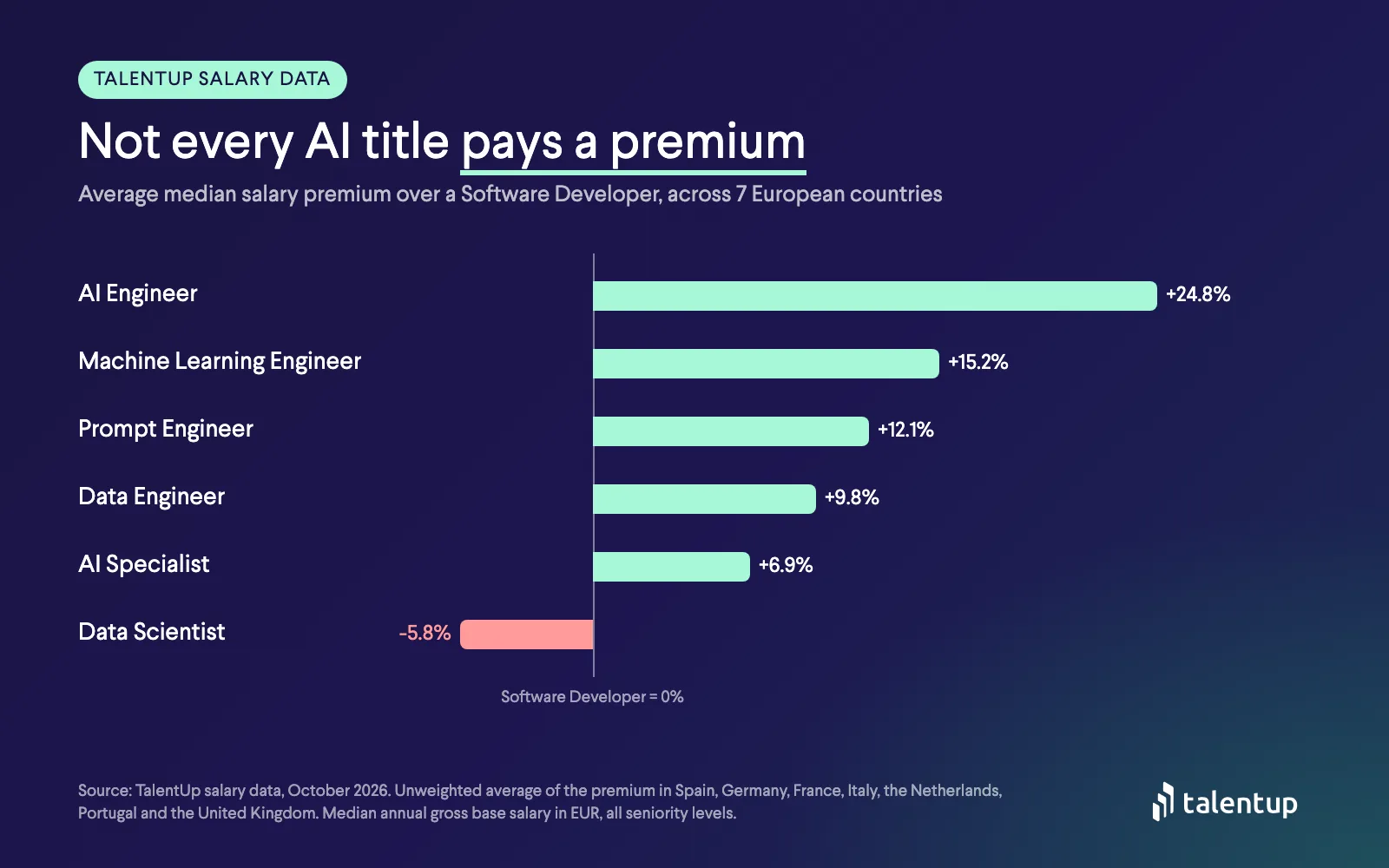
Not every AI title pays a premium. Source: TalentUp salary benchmarks, October 2026.
- AI Engineers (+24.8%) and Machine Learning Engineers (+15.2%) command the clearest premiums. These roles build and deploy AI systems in production, combining software engineering with specialised knowledge of models.
- Prompt Engineers (+12.1%) show a premium on average, but it is highly volatile: +29.8% in the United Kingdom and +25.6% in Portugal, but −10.6% in the Netherlands. This is typical of a new, poorly standardised job title.
- Data Engineers (+9.8%) and AI Specialists (+6.9%) earn a moderate premium.
- Data Scientists earn 5.8% less than Software Developers on average, and less in five of the seven countries. Supply has grown, and much of the work has been commoditised by tools and platforms.
Job ads show why. In the US, 72% of data scientist ads already ask for AI skills (LLMs, machine learning frameworks, generative AI), and those ads offer no more than the rest (−1.7%, n = 751 vs 294). When a skill is part of the job’s baseline, it stops earning a premium.
The opposite happens in roles where AI skills are still the exception. Among software engineer ads, the ones that explicitly ask for AI skills offered 6.3% more in the US (n = 2,367 vs 7,932), 4.3% more in Canada (n = 359 vs 1,408) and 23.6% more in the UK (n = 64 vs 308, a small sample). US product manager ads asking for AI skills offered 8.1% more (n = 570 vs 1,846), slightly more than the 5.1% premium for ads titled “AI product manager” (n = 86).
| Role family (US ads, 2026) |
Share of ads asking for AI skills |
Premium for asking for AI skills |
| Software engineer |
23.0% |
+6.3% |
| Product manager |
23.6% |
+8.1% |
| Data scientist |
71.9% |
−1.7% |
The lesson is clear: the market pays for scarce skills, not for titles. Roles that combine AI expertise with the ability to build production systems are rewarded; roles whose AI skills have become standard are not. Pricing an AI role on its title alone risks overpaying for some profiles and underpaying those you most need to retain.
HR teams often see very different numbers for the same question. They are usually all correct, because they measure different comparisons:
| Source |
What it compares |
AI premium |
| PwC 2026 Global AI Jobs Barometer |
Job ads requiring AI skills vs similar jobs without them, across occupations and sectors in 27 countries and territories |
62% on average (57% in the previous edition); 16% in government to 118% in consumer markets |
| Bone, Ehlinger & Stephany (2025), UK |
Over 10 million UK vacancies, 2018–2024, jobs specifying AI skills vs others |
23% (36% in science, engineering and tech jobs) |
| Alekseeva et al. (2021), US |
US job postings 2010–2019, AI skills vs no AI skills |
11% within the same firm, 5% within the same job title |
| TalentUp benchmarks, Europe |
AI Engineer vs Software Developer, median base salary |
24.8% (7 countries) |
| TalentUp job ads, 2026 |
AI engineering titles vs software engineer titles |
+5.1% (US) to +30.3% (UK) |
The pattern is consistent. The broader the comparison, the bigger the premium: across the whole economy, AI skills mark out better-paid jobs, firms and sectors (PwC, 2026). The closer the comparison, the smaller it gets: within the same job title, peer-reviewed research found a premium of about 5% in the US (Alekseeva et al., 2021), very close to the 4–6% TalentUp finds today for US and Canadian software engineers with AI skills.
For a compensation decision, the close comparison is the one that matters: what you need to pay on top of the role you would otherwise hire. That is why we benchmark AI roles against software engineers rather than against the whole labour market.
How to Price AI Roles: A Framework for C&B Teams
1. Define AI Roles by Skills, Not Titles
Describe what each role actually does: building and deploying models, fine-tuning large language models, building AI agents, designing data pipelines, integrating AI into products or using AI tools in a business function. Map these skills and responsibilities into your job architecture before looking at market data, and use them to build salary bands that reflect real differences in work.
2. Benchmark Against the Right Peer Group
AI roles are new and data is still thin, so use multiple reference points: the closest AI role, the closest traditional role (such as software engineer or data engineer) and the premium between them, by country, city and seniority. Our step-by-step guide to implementing salary benchmarking explains how to choose sources and match roles, and for titles that barely existed a year ago, use the proxy method in our guide to pay ranges for emerging roles.
3. Decide How to Deliver the Premium
There are three main options, and many companies combine them:
| Option |
Best for |
Risk |
| Separate salary band for AI roles |
Clearly distinct roles with a stable premium, such as AI or ML engineer |
Hard to reverse if the premium shrinks |
| Skills premium or allowance on top of an existing band |
Engineers or product managers who add AI skills to their role |
Needs clear, verifiable skill criteria |
| Variable pay and retention instruments |
Scarce individuals and critical projects |
Can hide pay gaps if not documented |
Sign-on bonuses, retention bonuses and long-term incentives reward scarce skills without permanently raising fixed costs.
4. Fund It Within a Tight Budget
With 2027 salary increase budgets at roughly 2.5–3% in most of Western Europe, paying an AI premium means making choices. The most effective approach is a dedicated market adjustment pool for critical, scarce skills, separate from the general merit budget. It keeps the premium visible, limits it to the roles that need it and avoids diluting merit increases for everyone else. Our guide to pay differentiation shows how far a limited budget goes when you concentrate it.
5. Build as Well as Buy
In Germany, hiring an AI Engineer instead of a Software Developer costs about €19,300 more per year in base salary alone, according to TalentUp benchmarks. For many companies, upskilling existing engineers is a faster and cheaper way to build AI capability. Linking a defined skills premium to demonstrated AI competencies also gives internal talent a clear career path.
6. Protect Internal Equity
A large premium for a small group can create tension with colleagues who work alongside them, especially experienced software developers. Be transparent about why the premium exists, which skills it rewards and how others can access it, and check regularly for pay compression between new AI hires and long-serving staff.
7. Review the Premium Every Year
Skill premiums are not permanent. The data scientist example shows how quickly a premium can disappear as supply grows and tools mature. Review AI premiums at least annually, and every six months for the newest titles, and be ready to adjust them in both directions.
The AI Pay Premium and Pay Transparency
The EU Pay Transparency Directive (2023/970) requires pay structures based on objective, gender-neutral criteria, including skills, effort, responsibility and working conditions. Member states had to transpose it by 7 June 2026, and its obligations apply through national laws once transposed, so check the rules in each country where you employ people. Paying more for AI skills is compatible with the Directive, provided the premium is linked to clearly defined skills and applied consistently.
There is a real risk, though. Technical and AI roles are still male-dominated in many companies, so a growing AI premium can widen the gender pay gap you will have to report: employers with 250 or more workers report every year and those with 150–249 every three years, both from 7 June 2027. If an unexplained gap of 5% or more in a category of workers is not remedied within six months, a joint pay assessment is required, and in pay discrimination claims the burden of proof shifts to the employer.
To manage it, document the criteria behind every premium, apply the same premium to everyone with the same skills, track the impact in your pay equity audit and open AI upskilling programmes to all employees. For the full list of obligations, see our EU Pay Transparency Directive guide.
A Note on the EU AI Act
If your HR team uses AI tools for recruitment, performance evaluation or other employment decisions, these are classified as high-risk AI systems under the EU AI Act. Following the Digital Omnibus on AI, the obligations for stand-alone high-risk systems now apply from 2 December 2027 instead of 2 August 2026 (Regulation (EU) 2026/1744). Use the extra time to review how AI is used in pay and talent decisions.
AI Pay Premium Checklist for 2027
- Identify the AI skills that are truly critical for your business in 2027.
- Map AI roles by skills in your job architecture, not by job title.
- Benchmark each role against both the closest AI role and the closest traditional role, by country, city and seniority.
- Use the close comparison (role vs role, or same role with and without AI skills), not economy-wide headline figures.
- Choose how to deliver the premium: separate band, skills allowance or variable pay.
- Fund it from a dedicated pool for critical skills, separate from merit.
- Compare the cost of hiring with the cost of upskilling existing employees.
- Check internal equity and the gender pay gap impact before approving premiums.
- Review premiums at least annually against current market data.
The AI pay premium is real, but it is more selective than the headlines suggest: about a quarter for AI engineers in European benchmarks, single digits for AI titles in North America, and nothing for some AI-heavy roles. The challenge for C&B teams in 2027 is to pay for scarce skills precisely and document every decision. The TalentUp Salary Benchmarking Platform gives you AI, data and technology salary benchmarks by seniority, company size and city to do exactly that.
Sources
- TalentUp. (2026). TalentUp Salary Benchmarking Platform: AI, data and software roles in seven European countries [Data set], October 2026. https://talentup.io/insights/
- TalentUp. (2026). TalentUp job postings database: salaried AI, ML, data science, software engineering and product management ads, January–September 2026 [Data set; analysis by TalentUp, October 2026]. https://talentup.io/methodology/
- Alekseeva, L., Azar, J., Giné, M., Samila, S., & Taska, B. (2021). The demand for AI skills in the labor market. Labour Economics, 71, 102002. https://doi.org/10.1016/j.labeco.2021.102002
- Bone, M., Ehlinger, E., & Stephany, F. (2025). Skills or degree? The rise of skill-based hiring for AI and green jobs. Technological Forecasting and Social Change. Summary: Oxford Internet Institute. https://www.oii.ox.ac.uk/practical-expertise-drives-salary-premiums-in-the-ai-sector-finds-new-oxford-study/
- European Parliament & Council of the European Union. (2023). Directive (EU) 2023/970 to strengthen the application of the principle of equal pay for equal work or work of equal value between men and women through pay transparency and enforcement mechanisms. https://eur-lex.europa.eu/eli/dir/2023/970/oj
- Eurostat. (2025a). ICT specialists – statistics on hard-to-fill vacancies in enterprises. Statistics Explained. https://ec.europa.eu/eurostat/statistics-explained/index.php?title=ICT_specialists_-_statistics_on_hard-to-fill_vacancies_in_enterprises
- Eurostat. (2025b). Use of artificial intelligence in enterprises. Statistics Explained. https://ec.europa.eu/eurostat/statistics-explained/index.php?title=Use_of_artificial_intelligence_in_enterprises
- PwC. (2026, June 15). AI reshapes global labour market into two distinct paths, rewarding human skills: PwC 2026 Global AI Jobs Barometer [Press release]. https://www.pwc.com/gx/en/news-room/press-releases/2026/pwc-2026-ai-jobs-barometer.html
- Regulation (EU) 2026/1744 amending Regulation (EU) 2024/1689 as regards the simplification of the implementation of harmonised rules on artificial intelligence (Digital Omnibus on AI). Official Journal of the European Union. https://eur-lex.europa.eu/eli/reg/2026/1744/oj/eng