
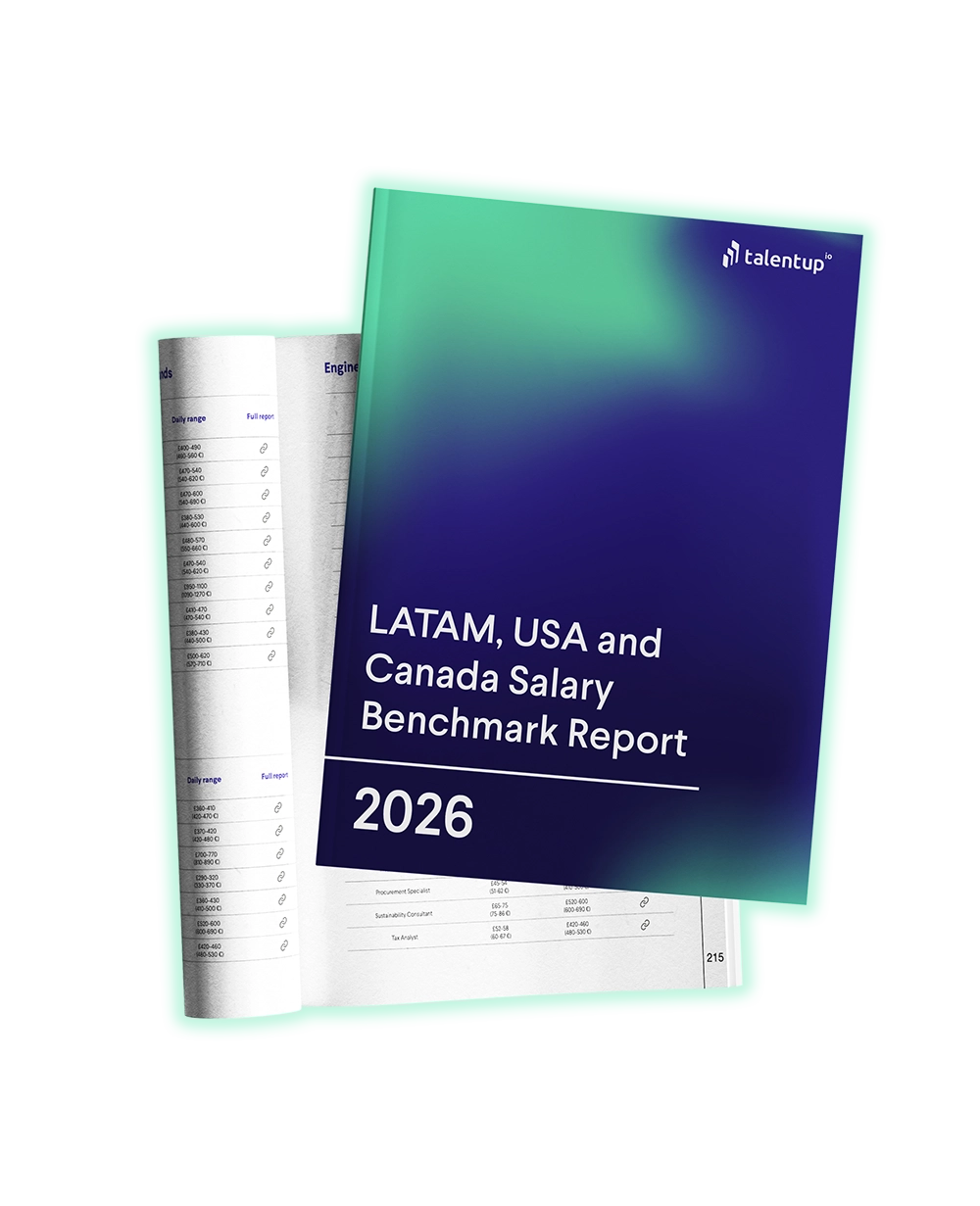
LATAM, USA and Canada Salary Benchmark Report 2026
Comprehensive gross salary benchmarks for professionals across Latin America, the United States and Canada. These data sets provide detailed insights into compensation structures across SMEs, startups, and corporates, allowing for precise comparisons by department and hierarchy level.
Argentina
Administrative Support Salary Bands
| Position |
SMEs
SMEs refer to micro, small and medium-sized companies, ranging from very small teams to organizations with up to 250 employees. These companies typically have more limited resources than large organizations and may be in earlier stages of development. As a result, salary bands in SMEs tend to be lower on average, though this varies by sector and maturity. To compensate, SMEs may offer greater flexibility or performance, and equity-based compensation.
|
Startups
Startups are companies in a growth-oriented phase, usually operating in the Information Technology sector. Their funding ranges from $20M to over $100M, indicating strong financial backing and potential for rapid expansion. Salary bands in startups are generally competitive, often including a mix of base salary, bonuses, and stock options to attract and retain talent in a highly competitive market.
|
Corporates
Corporates are large-scale companies with 10,001+ employees. These organizations are well-established and typically have stable revenue streams. Salary bands in corporates tend to be structured and predictable, reflecting seniority levels, formal HR policies, and standardized compensation frameworks.
|
View more
|
|---|---|---|---|---|
| Administrative Coordinator | 14k - 17k $ | 14k - 18k $ | 16k - 20k $ | View Position |
| Administrative Manager | 27k - 38k $ | 31k - 40k $ | 46k - 58k $ | View Position |
| Office Administrator | 18k - 22k $ | 19k - 22k $ | 18k - 20k $ | View Position |
| Office Coordinator | 20k - 22k $ | 20k - 23k $ | 25k - 28k $ | View Position |
| Payroll Administrator | 14k - 15k $ | 15k - 17k $ | 17k - 19k $ | View Position |
| Payroll Consultant | 20k - 22k $ | 19k - 23k $ | 18k - 21k $ | View Position |
| Payroll Manager | 27k - 30k $ | 35k - 41k $ | 41k - 49k $ | View Position |
Consulting And Advisory Salary Bands
| Position |
SMEs
SMEs refer to micro, small and medium-sized companies, ranging from very small teams to organizations with up to 250 employees. These companies typically have more limited resources than large organizations and may be in earlier stages of development. As a result, salary bands in SMEs tend to be lower on average, though this varies by sector and maturity. To compensate, SMEs may offer greater flexibility or performance, and equity-based compensation.
|
Startups
Startups are companies in a growth-oriented phase, usually operating in the Information Technology sector. Their funding ranges from $20M to over $100M, indicating strong financial backing and potential for rapid expansion. Salary bands in startups are generally competitive, often including a mix of base salary, bonuses, and stock options to attract and retain talent in a highly competitive market.
|
Corporates
Corporates are large-scale companies with 10,001+ employees. These organizations are well-established and typically have stable revenue streams. Salary bands in corporates tend to be structured and predictable, reflecting seniority levels, formal HR policies, and standardized compensation frameworks.
|
View more
|
|---|---|---|---|---|
| Advisor | View Position | |||
| Analyst | View Position | |||
| Consultant | View Position |
Customer Support Salary Bands
| Position |
SMEs
SMEs refer to micro, small and medium-sized companies, ranging from very small teams to organizations with up to 250 employees. These companies typically have more limited resources than large organizations and may be in earlier stages of development. As a result, salary bands in SMEs tend to be lower on average, though this varies by sector and maturity. To compensate, SMEs may offer greater flexibility or performance, and equity-based compensation.
|
Startups
Startups are companies in a growth-oriented phase, usually operating in the Information Technology sector. Their funding ranges from $20M to over $100M, indicating strong financial backing and potential for rapid expansion. Salary bands in startups are generally competitive, often including a mix of base salary, bonuses, and stock options to attract and retain talent in a highly competitive market.
|
Corporates
Corporates are large-scale companies with 10,001+ employees. These organizations are well-established and typically have stable revenue streams. Salary bands in corporates tend to be structured and predictable, reflecting seniority levels, formal HR policies, and standardized compensation frameworks.
|
View more
|
|---|---|---|---|---|
| Customer Service Representative | View Position | |||
| Customer Service Specialist | View Position | |||
| Customer Success Specialist | View Position |
Design, Media, And Writing Salary Bands
| Position |
SMEs
SMEs refer to micro, small and medium-sized companies, ranging from very small teams to organizations with up to 250 employees. These companies typically have more limited resources than large organizations and may be in earlier stages of development. As a result, salary bands in SMEs tend to be lower on average, though this varies by sector and maturity. To compensate, SMEs may offer greater flexibility or performance, and equity-based compensation.
|
Startups
Startups are companies in a growth-oriented phase, usually operating in the Information Technology sector. Their funding ranges from $20M to over $100M, indicating strong financial backing and potential for rapid expansion. Salary bands in startups are generally competitive, often including a mix of base salary, bonuses, and stock options to attract and retain talent in a highly competitive market.
|
Corporates
Corporates are large-scale companies with 10,001+ employees. These organizations are well-established and typically have stable revenue streams. Salary bands in corporates tend to be structured and predictable, reflecting seniority levels, formal HR policies, and standardized compensation frameworks.
|
View more
|
|---|---|---|---|---|
| Design Manager | View Position | |||
| Designer | View Position | |||
| Game Designer | View Position | |||
| Graphic Designer | View Position | |||
| Translator | View Position | |||
| User Experience Designer | View Position | |||
| User Interface Designer | View Position | |||
| Visual Designer | View Position | |||
| Web Designer | View Position |
Engineering And Technical Salary Bands
| Position |
SMEs
SMEs refer to micro, small and medium-sized companies, ranging from very small teams to organizations with up to 250 employees. These companies typically have more limited resources than large organizations and may be in earlier stages of development. As a result, salary bands in SMEs tend to be lower on average, though this varies by sector and maturity. To compensate, SMEs may offer greater flexibility or performance, and equity-based compensation.
|
Startups
Startups are companies in a growth-oriented phase, usually operating in the Information Technology sector. Their funding ranges from $20M to over $100M, indicating strong financial backing and potential for rapid expansion. Salary bands in startups are generally competitive, often including a mix of base salary, bonuses, and stock options to attract and retain talent in a highly competitive market.
|
Corporates
Corporates are large-scale companies with 10,001+ employees. These organizations are well-established and typically have stable revenue streams. Salary bands in corporates tend to be structured and predictable, reflecting seniority levels, formal HR policies, and standardized compensation frameworks.
|
View more
|
|---|---|---|---|---|
| Architect | View Position | |||
| Civil Engineer | View Position | |||
| Electrical Engineer | View Position | |||
| Electronics Engineer | View Position | |||
| Engineer | View Position | |||
| Mechanical Engineer | View Position | |||
| Process Engineer | View Position | |||
| Project Engineer | View Position | |||
| Technical Designer | View Position | |||
| Test Engineer | View Position | |||
| Validation Engineer | View Position |
Finance Salary Bands
| Position |
SMEs
SMEs refer to micro, small and medium-sized companies, ranging from very small teams to organizations with up to 250 employees. These companies typically have more limited resources than large organizations and may be in earlier stages of development. As a result, salary bands in SMEs tend to be lower on average, though this varies by sector and maturity. To compensate, SMEs may offer greater flexibility or performance, and equity-based compensation.
|
Startups
Startups are companies in a growth-oriented phase, usually operating in the Information Technology sector. Their funding ranges from $20M to over $100M, indicating strong financial backing and potential for rapid expansion. Salary bands in startups are generally competitive, often including a mix of base salary, bonuses, and stock options to attract and retain talent in a highly competitive market.
|
Corporates
Corporates are large-scale companies with 10,001+ employees. These organizations are well-established and typically have stable revenue streams. Salary bands in corporates tend to be structured and predictable, reflecting seniority levels, formal HR policies, and standardized compensation frameworks.
|
View more
|
|---|---|---|---|---|
| Accountant | View Position | |||
| Accounting Specialist | View Position | |||
| Claims Manager | View Position | |||
| Finance Analyst | View Position | |||
| Finance Manager | View Position | |||
| Investment Analyst | View Position | |||
| Investment Manager | View Position | |||
| Procurement Manager | View Position | |||
| Procurement Specialist | View Position | |||
| Sustainability Consultant | View Position | |||
| Tax Accountant | View Position | |||
| Tax Manager | View Position |
Human Resources Salary Bands
| Position |
SMEs
SMEs refer to micro, small and medium-sized companies, ranging from very small teams to organizations with up to 250 employees. These companies typically have more limited resources than large organizations and may be in earlier stages of development. As a result, salary bands in SMEs tend to be lower on average, though this varies by sector and maturity. To compensate, SMEs may offer greater flexibility or performance, and equity-based compensation.
|
Startups
Startups are companies in a growth-oriented phase, usually operating in the Information Technology sector. Their funding ranges from $20M to over $100M, indicating strong financial backing and potential for rapid expansion. Salary bands in startups are generally competitive, often including a mix of base salary, bonuses, and stock options to attract and retain talent in a highly competitive market.
|
Corporates
Corporates are large-scale companies with 10,001+ employees. These organizations are well-established and typically have stable revenue streams. Salary bands in corporates tend to be structured and predictable, reflecting seniority levels, formal HR policies, and standardized compensation frameworks.
|
View more
|
|---|---|---|---|---|
| Benefits Advisor | View Position | |||
| Human Resources Business Partner | View Position | |||
| Human Resources Generalist | View Position | |||
| Human Resources Manager | View Position | |||
| Human Resources Specialist | View Position |
Bolivia
Brazil
Canada
Chile
Colombia
Dominican Republic
Mexico
Peru
United States
Uruguay
Methodology
TalentUp provides access to a vast amount of data, including information on more than 250 million professionals, 45 million salaries, and 8 million businesses. Every month, TalentUp regularly updates this data, offering a current perspective on the market.
The platform enables users to compare worker salaries to market rates, conduct competitor research, and compare salaries across various cities. With a wide range of over 700 positions available in more than 300 locations, TalentUp equips you with the necessary insights to remain competitive in the current job market.
Collect data
We gather data from over 300 trusted sources, including job boards and social networks, ensuring it is comprehensive and up-to-date. We consolidate this collected data into a user-friendly database, which serves as a fundamental resource for our platform. In TalentUp, clients can trust the accuracy, reliability, and relevance of data.

Normalize data
Our aim is to make data comparable, accurate, and user-friendly. Our team of experts diligently transforms data from various languages, fields, and formats into standardized formats for in-depth analysis. TalentUp simplifies data understanding, providing clients with clear and actionable insights that drive business progress.

Remove duplicate data
To ensure precision and currency, we eliminate duplicate data by cross referencing information sources. Using a sophisticated algorithm, we identify synonyms and variations in job titles, mapping them to a standardized title. This meticulous approach guarantees the most precise and current information for clients.

Data validation
We validate data accuracy by examining patterns from various sources. For instance, when assessing salaries, we consider factors such as seniority, experience, and required skills, comparing job profiles with similar ones in comparable companies. Our experts use this methodology to assess new salary data, ensuring that the data clients receive is precise, dependable, and pertinent.
Frequently Asked Questions
Common questions about the LATAM, USA and Canada Salary Benchmark Report.
Yes. TalentUp's LATAM, USA and Canada Salary Benchmark Report 2026 is completely free, covering 11 countries with 1,215 verified compensation data points across SMEs, Startups and Corporates.

Unlock the full LATAM, USA and Canada Salary Benchmark Report 2026!
You’re viewing a limited version of the report. Log in to reveal all benchmarks across every covered position, department and country.