We use cookies to improve your experience and for marketing. Visit our Cookies Policy to learn more.
Your message has been sent.
Thank you for getting in touch with TalentUp. We will respond you as soon as possible.
The Pay Transparency Tool to Prepare for the EU Directive Before It Becomes a Legal Risk
The EU Pay Transparency Directive (EU 2023/970) will soon require companies across Europe to disclose salary ranges, report gender pay gaps, and justify pay differences. With TalentUp, you can upload your workforce data and instantly benchmark salaries, detect pay gaps, and prepare compliance-ready insights.
Companies that prepare early reduce compliance risk by up to 80% while building a more competitive and transparent compensation strategy.
00
days
:
00
hours
:
00
minutes
:
00
seconds
The deadline has passed. Companies that prepared are already ahead. It's not too late — start your compliance review today.
Turn pay transparency into a competitive advantage
TalentUp's pay transparency tool transforms complex regulatory requirements into clear, actionable compensation insights. Upload your workforce data and instantly analyze salaries across your entire organization.
100%
Benchmark 100% of your workforce against the market
80%
Preparing early for Pay Transparency helps companies reduce compliance risk up to 80%.
35%
Companies using modern salary benchmarking platforms improve compensation decisions by up to 35%.
Employees can claim full back pay for discrimination, including bonuses and benefits.
Regulatory Fines
National authorities can impose financial penalties, potentially reaching thousands of euros depending on national legislation.
Exclusion from public contracts
Companies that fail to comply may be excluded from public procurement processes.
Reputational damages
Pay transparency violations can significantly damage employer brand, employee trust, and investor confidence.
TalentUp is a member of the Pay Transparency Alliance
The Pay Transparency Alliance is a collective of organizations and individuals united by a shared commitment to advancing pay transparency across industries.
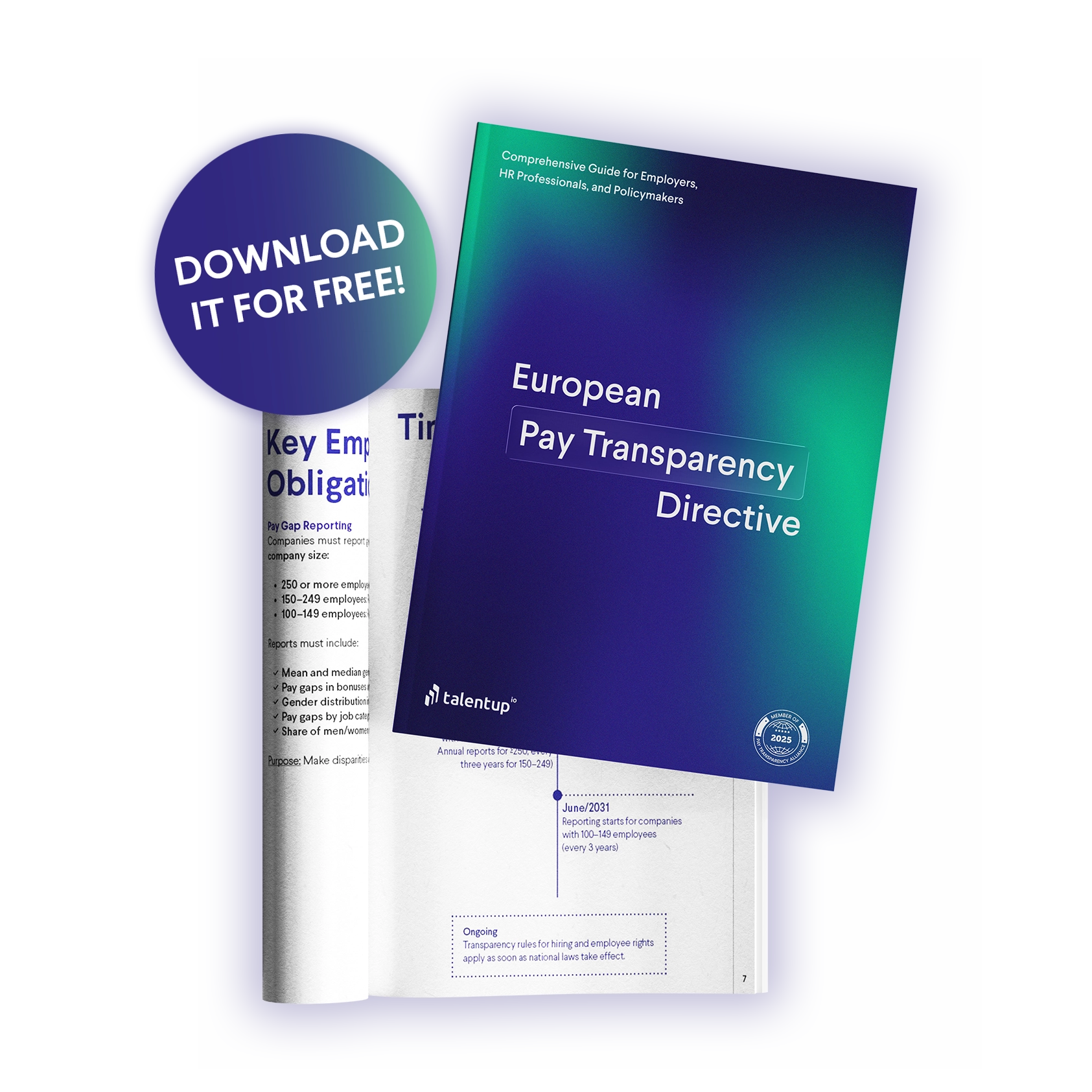
Equip your organization to navigate the EU Pay Transparency Directive with confidence using our end-to-end guide, covering everything from pre-hiring transparency and information rights to the critical reporting timelines approaching in 2026.
Partial transposition – 8 measures notified, all at Land level (Styria) and covering public-sector staff only. No federal transposition law for private-sector employers; infringement proceedings risk.
Austria's 8 notified measures are exclusively Styrian (Steiermark) provincial laws applying to provincial and municipal public employees: the Styrian Civil Service and Remuneration Act (L-DBR), the Styrian Equal Treatment Act 2023 as amended by LGBl. 53/2026 of 12 June 2026 and LGBl. 70/2026 of 21 July 2026, the Styrian job-grading regulation (StEVO, LGBl. 46/2025), the Staff Representation Act 1999, the Employee Protection Act 2000 and the Web Accessibility Act. No federal act covering private-sector employers has been notified, so most of the Directive's obligations remain untransposed and Austria is exposed to infringement proceedings. View more
belgium
Partial transposition – 6 measures notified; Flemish pay transparency decree published in the Belgisch Staatsblad on 17 June 2026. Federal and other regional obligations still pending.
Belgium has notified 6 measures. The key new instrument is the Flemish 'Decreet over beloningstransparantie en maatregelen voor gelijke beloning', published in the Belgisch Staatsblad on 17 June 2026, alongside a Flemish decree of 3 June 2026 amending the 2008 equal opportunities and equal treatment framework and the Flemish Human Rights Institute decree, and a Brussels-Capital Region order of 11 June 2026 implementing the talentAnalytics.brussels database. The other notified items are older instruments (the Walloon public service code, a 2023 Flemish order on local and provincial staff and a 2024 French Community anti-discrimination decree). Transposition is therefore fragmented across the federal and regional levels and remains incomplete. View more
bulgaria
Partial transposition – 12 measures notified, including Labour Code amendments (State Gazette 16/2026, 10 February 2026) and an Anti-Discrimination Act amendment (State Gazette 30, 27 March 2026); latest notified item 26 May 2026.
Bulgaria has notified 12 measures. Rather than adopting a single act, it amended existing legislation: the Labour Code, the Civil Servant Act, the Concessions Act, the Public Procurement Act, the Whistleblower Protection Act and the Administrative Offences and Penalties Act (published in State Gazette No. 16 and No. 17 of February 2026), the Protection Against Discrimination Act (State Gazette No. 30 of 27 March 2026) and the rules of procedure of the Commission for Protection against Discrimination (State Gazette No. 48 of 26 May 2026), together with the Ordinance on the structure and organisation of wages (State Gazette No. 115 of 30 December 2025) and the Employment Promotion Act. Transposition is therefore spread across several instruments and is best classified as partial at the 7 June 2026 deadline. View more
croatia
Deadline missed – no draft law, no timeline. Croatia is among the least advanced member states. Infringement proceedings risk.
No formal draft published and no implementation timeline announced as of June 2026. Croatia missed the 7 June 2026 transposition deadline. ETUC confirmed Croatia among the countries with 'no draft published and no timeline'. Euronews listed Croatia alongside countries with no draft. Croatia is among the least advanced EU member states on this Directive. Some early-stage awareness activities have been noted by the Ministry of Labour. View more
cyprus
Deadline missed – draft bill published November 2025, still in legislative process. Cyprus did not enact the law by 7 June 2026.
Cyprus published a draft bill in November 2025 for public consultation that closely tracks the Directive's requirements. However, the bill had not been enacted into law by the 7 June 2026 deadline. Cyprus is classified as 'in progress' but having missed the deadline. The draft was published via the official government e-consultation portal and covers the main Directive requirements including pay range disclosure, reporting, and enforcement. View more
czech republic
Partial transposition – 31 measures notified; the most recent is Act No. 120/2025 Sb. amending the Labour Code (April 2025). No 2026 measure has been notified.
Czechia has notified 31 measures. The most recent are Act No. 120/2025 Sb. of 29 April 2025 amending the Labour Code, Act No. 84/2025 Sb. and Act No. 77/2025 Sb. amending the Public Defender of Rights Act. The remainder are long-standing instruments: the Labour Code (262/2006 Sb.), the Anti-Discrimination Act (198/2009 Sb.), the Labour Inspection Act (251/2005 Sb.), the Civil Procedure Code (99/1963 Sb.) and the Code of Administrative Justice. EUR-Lex records no Czech measure adopted in 2026, so a March 2026 Labour Code amendment is not reflected in the official notification; the pay-secrecy ban in force since 2025 remains the main substantive change. View more
denmark
Deadline missed – officially delayed to 1 January 2027. Draft bill for amending Equal Pay Act released 26 February 2026 for consultation.
Denmark formally confirmed it will miss the 7 June 2026 deadline and plans to implement by 1 January 2027. A consultation draft bill was released on 26 February 2026, amending Denmark's existing Equal Pay Act (Ligelønsloven). Denmark builds on a strong tradition of social dialogue and an existing equal pay framework. The draft bill is expected to be submitted to Parliament in Q3 2026 for entry into force on 1 January 2027. View more
estonia
Partial/formal transposition – 18 measures notified; Employment Contracts Act and Civil Service Act amendments published 3 July 2026. No single dedicated pay transparency act.
Estonia has notified 18 national measures and is transposing the Directive by amending existing legislation rather than adopting a single pay transparency act. Notified instruments include the Gender Equality Act, the Equal Treatment Act (RT I, 17.03.2026), the Employment Contracts Act and the Civil Service Act (amended RT I, 03.02.2026 and again RT I, 03.07.2026), the Trade Unions Act, the Employee Representatives Act, the Labour Inspectorate statutes, the procedural codes, the Public Procurement Act and the Penal Code. The most recent measures were published on 3 July 2026, shortly after the deadline. View more
finland
Deadline missed – draft progressing through Parliament, targeting late 2026 entry into force. Finland officially announced a delay.
Finland had an updated draft transposition law in public consultation in late 2025. Despite this progress, Finland missed the 7 June 2026 transposition deadline. Finland was among the 10 countries that officially announced delays (per beqom analysis). The draft was progressing through the Finnish legislative process but had not been adopted by Parliament by the deadline. Finland has existing gender pay gap reporting obligations under the Act on Equality between Women and Men (Tasa-arvolaki), but these do not fully satisfy the Directive requirements. Finland is targeting late 2026 for entry into force. View more
france
Deadline missed – draft law published post-deadline (8 June 2026). Formal transposition requires Parliamentary approval, expected later in 2026. European Commission has urged full implementation.
A pre-draft bill (avant-projet de loi) was circulated to social partners on 6 March 2026. After consultations, the government transmitted a revised draft (projet de loi) to social partners on 5 June 2026 and published it on 8 June 2026 — one day after the transposition deadline. The bill has not yet been voted on by Parliament. The existing Index d'égalité professionnelle (mandatory since 2019 for companies with 50+ employees) remains the only operational framework. View more
germany
Deadline missed – no draft law submitted. Commission report published Nov 2025 targets 2027 implementation. European Commission has urged full implementation. Direct effect of the Directive in German law is being debated by legal scholars.
An 11-person expert commission published its final report in November 2025, recommending a bureaucracy-reduced implementation model and suggesting the individual right to information apply from 2027. No formal draft bill has been submitted to Parliament. Germany missed the 7 June 2026 transposition deadline. A Deloitte analysis notes that the EU Pay Transparency Directive may now need to be assessed for potential direct application in domestic law given the missed deadline. View more
greece
Transposed - dedicated implementing law published in the Government Gazette (FEK) A' 105 on 6 July 2026 and declared a complete transposition, one month after the 7 June 2026 deadline.
Greece adopted a dedicated implementing law, 'Strengthening the application of equal pay between men and women for equal work or work of equal value - incorporation of Directive (EU) 2023/970', published in the Government Gazette (FEK) Series A No. 105 of 6 July 2026. Greece has notified 5 measures in total; the other four are pre-existing instruments (Civil Code, Code of Civil Procedure and the 2016 public procurement and concessions laws), all declared as complete transposition. The law was enacted one month after the 7 June 2026 deadline. View more
hungary
Deadline missed – no draft law published, no implementation timeline announced. Hungary is among the most delayed member states. Infringement proceedings risk.
No official announcement or draft published as of June 2026. Hungary missed the 7 June 2026 transposition deadline with no concrete legislative activity reported. ETUC confirmed Hungary among the countries with 'no draft published and no timeline'. Hungary is among the least advanced EU member states on this Directive. Multiple trackers (ETUC, beqom) list Hungary in the 'no draft published, no timeline' category. View more
ireland
Deadline missed – partial legislative scheme published Jan 2025 but no full transposition enacted. Ireland missed the June 2026 deadline. Infringement proceedings risk.
Ireland published a General Scheme of the Equality (Miscellaneous Provisions) Bill 2024 in January 2025 as a partial framework. However, no complete transposition law was enacted by the 7 June 2026 deadline. ETUC confirmed Ireland among the countries with 'no draft published and no timeline' for full transposition. The January 2025 scheme covers some aspects but is not a full transposition. Ireland missed the deadline and is subject to potential infringement proceedings. View more
italy
Fully transposed – Legislative Decree No. 96 of 7 May 2026, published in Gazzetta Ufficiale No. 125 of 1 June 2026, in force from 7 June 2026. Italy met the transposition deadline.
Legislative Decree No. 96 of 7 May 2026 was approved by the Council of Ministers on 30 April 2026 in final examination and published in Gazzetta Ufficiale No. 125 of 1 June 2026. It entered into force on 7 June 2026, making Italy one of the first EU member states to fully transpose the Directive. The decree introduces pay transparency obligations, job-ad salary disclosure, reporting requirements for companies with 50+ employees (first report due June 2027) and strengthened enforcement mechanisms. It is the single measure Italy has notified to the Commission. View more
latvia
Deadline missed – no draft law, no timeline. Latvia is among the delayed member states. Infringement proceedings risk.
No draft law published and no implementation timeline announced as of June 2026. Latvia missed the 7 June 2026 transposition deadline. ETUC confirmed Latvia among the countries with 'no draft published and no timeline'. Latvia was listed among the group of countries that announced delays. The Ministry of Welfare (Labklājības ministrija) had conducted some preliminary consultations, but no formal draft was submitted. View more
lithuania
Fully transposed (phased) – Law No. XV-969 in force 7 June 2026; right to information delayed to 1 January 2027. Lithuania met the transposition deadline.
On 21 May 2026, Lithuania adopted Law No. XV-969, amending the Labour Code to formally transpose the EU Pay Transparency Directive. Most requirements entered into force on 7 June 2026. However, the individual right to pay information requirement has been phased – it will apply from 1 January 2027. Lithuania is among the small group of member states that met the June 2026 deadline. View more
luxembourg
Deadline missed – no draft law published, no timeline announced. Luxembourg is among the most delayed member states. Infringement proceedings risk.
No official announcement or draft published as of June 2026. Luxembourg missed the 7 June 2026 transposition deadline. Multiple sources confirm Luxembourg among the countries with no draft and no timeline. Euronews listed Luxembourg alongside Austria, Bulgaria, Croatia, Hungary and Portugal as countries with 'no draft published'. Luxembourg had consulted with social partners but no formal bill emerged before the deadline. View more
malta
Fully transposed – Equal Pay (Transparency and Reporting) Regulations 2026, Government Gazette No. 21,661 of 5 June 2026, completing the partial transposition of 2025. Malta met the deadline.
Malta transposed the Directive in two stages. Legal Notice 112 of 2025 (published 27 June 2025, in force 27 August 2025) introduced early partial transposition including pay range disclosure in job advertisements. The Equal Pay (Transparency and Reporting) Regulations 2026, published in the Malta Government Gazette No. 21,661 of 5 June 2026, completed transposition with the remaining obligations (pay reporting, right to information, enforcement). The 2026 Regulations are the single measure Malta has notified to the Commission, and full transposition was in place by the 7 June 2026 deadline. View more
netherlands
Deadline missed – officially delayed to 1 January 2027. Draft law expected to Parliament Q3/Q4 2026. Infringement proceedings risk.
The Netherlands formally confirmed it will miss the 7 June 2026 transposition deadline and has announced a delayed implementation target of 1 January 2027. A draft law is expected to be submitted to Parliament in Q3 or Q4 of 2026. The Dutch government had previously indicated the law would enter into force in January 2027. The Netherlands is subject to potential European Commission infringement proceedings for missing the deadline. View more
poland
Partial transposition – EUR-Lex records 10 measures; existing pay scale and recruitment rules in force. Full transposition bill pending Parliamentary adoption. ETUC classifies as 'delayed partial'.
Poland has partially transposed the Directive. An Act on pay scale disclosure and gender-neutral job titles entered into force in 2025. An updated full transposition draft was published on 4 May 2026. EUR-Lex records 10 national measures formally communicated by Poland. However, ETUC classifies Poland as 'delayed partial transposition' as the complete framework was not enacted by 7 June 2026. The full transposition bill is still making its way through Parliament. View more
portugal
Deadline missed – no draft law published, no timeline. Portugal is among the most delayed member states. Infringement proceedings risk.
No draft law published and no implementation timeline announced as of June 2026. Portugal missed the 7 June 2026 transposition deadline. Euronews and ETUC listed Portugal among the countries with no draft published. Portugal is among the group of least advanced EU member states. Multiple trackers confirm Portugal in the 'no draft, no timeline' category. Existing gender pay gap legislation (Law 60/2018 on equal pay) provides a partial existing framework. View more
romania
Formal notification only – 27 measures notified but the most recent dates from November 2024. No dedicated transposition act published by the 7 June 2026 deadline.
Romania has notified 27 measures, all of which are pre-existing instruments: the Labour Code (Law 53/2003), Law 202/2002 on equal opportunities and treatment between women and men and its successive amendments, Government Ordinance 137/2000 on preventing and sanctioning discrimination, Law 108/1999 establishing the Labour Inspection, the Civil Code and the Civil Procedure Code, the Social Dialogue Act (Law 367/2022), the 2016 public procurement and concessions laws and Law 283/2024 on adequate minimum wages. The most recent notified measure dates from November 2024, so the high number of measures reflects formal notification of existing law rather than new pay transparency legislation. View more
slovakia
Fully transposed – Act No. 76/2026 Z. z. on equal pay published in the Collection of Laws on 8 May 2026 and in force from 7 June 2026. Slovakia was the first member state to complete transposition.
Slovakia was the first EU member state to adopt a complete transposition law. Act No. 76/2026 Z. z. on equal pay for men and women for equal work or work of equal value was published in the Collection of Laws (Zbierka zákonov SR) on 8 May 2026 and entered into force on 7 June 2026. It amends, among others, the Labour Code (Act No. 311/2001 Z. z.) and the Labour Inspection Act (Act No. 125/2006 Z. z.), introducing pay disclosure in recruitment, an individual right to pay information, gender pay gap reporting, joint pay assessment and strengthened enforcement by the Labour Inspectorate. Slovakia has notified 21 measures in total. View more
slovenia
Formal notification only – 16 measures notified, all pre-existing legislation (latest October 2025). No dedicated transposition act; the 7 June 2026 deadline was missed.
Slovenia has notified 16 measures, but all of them are pre-existing instruments: the Employment Relationships Act, the Worker Participation in Management Act, the Protection Against Discrimination Act, the Labour Inspection Act, the Labour and Social Courts Act, the Civil Procedure Act, the General Administrative Procedure Act, the Obligations Code, the Minor Offences Act, the Criminal Code, the Public Procurement Act and the 2024 public-sector pay framework act (ZSTSPJS). The most recent notified item dates from October 2025, so no new pay transparency legislation has been adopted and the substantive obligations of the Directive are not yet in national law. A working group has been set up but no draft act has been published. View more
spain
Formal notification only – 10 measures notified, all pre-existing (including RD 902/2020 and RD 901/2020). No dedicated transposition law; the 7 June 2026 deadline was missed.
Spain has notified 10 measures, all of them pre-existing: the Spanish Constitution, Law 50/1997 on the Government, the consolidated Law on Infringements and Penalties in the Social Order (RDL 5/2000), Organic Law 3/2007 on effective equality between women and men, Law 36/2011 on social jurisdiction, Law 39/2015 on common administrative procedure, the Workers' Statute (RDL 2/2015), Law 9/2017 on public sector contracts and Royal Decrees 901/2020 (equality plans) and 902/2020 (equal pay). The most recent dates from 2020, so Spain is relying on its existing pay-equity framework and has not adopted new legislation covering the Directive's job-advert disclosure, information rights, reporting and joint pay assessment obligations. View more
sweden
Deadline missed – transposition formally halted in March 2026 and the draft suspended; entry into force targeted for late 2026 / early 2027. EUR-Lex records 33 notified measures, all pre-existing.
Sweden has notified 33 measures, but all of them are pre-existing instruments such as the Discrimination Act (2008:567), the Act on the Equality Ombudsman (2008:568), the Employment Protection Act (1982:80), the Co-Determination Act (1976:580), the Code of Judicial Procedure, the three 2016 public procurement acts and the Budget Act. The most recent notified item is Ordinance (2026:202) of 10 March 2026 amending the Official Statistics Ordinance. Dedicated transposition work was formally halted in March 2026 and the draft suspended, with entry into force now targeted for late 2026 or early 2027, so the Directive's pay transparency obligations are not yet in Swedish law. View more
Last updated on 31/07/2026
Frequently asked questions
Answers to the most frequently asked questions regarding Pay Transparency
The EU Pay Transparency Directive is a legal framework introduced by the European Union to reduce gender pay gaps and ensure fair, transparent, and non-discriminatory pay practices across all member states. It introduces mandatory salary transparency in job postings, prohibits employers from asking candidates about their pay history, and requires companies to explain how they determine salaries and career progression. The directive also reinforces the principle that work of equal value must be paid equally. Employers must evaluate roles using objective and gender-neutral criteria such as skills required, responsibility levels, effort, and working conditions. If employees performing work of equal value show a pay difference of more than 5% without a justified reason, the employer must take corrective action. This threshold is meant to stop hidden or systemic pay discrimination and to ensure that all similar roles are treated fairly.
All employers operating within the European Union must comply with the directive. If your company employs workers within EU borders, the directive applies to you.
EU member states have until 2026 to transpose the directive into national law. Some countries may implement it earlier. Employers should already start preparing because compliance requires significant internal work, especially around salary structures and HR processes.
Yes. The directive requires employers to disclose the initial pay or pay range upfront in the job posting. This range must be realistic, consistent with internal compensation structures, and based on objective criteria.
No. Employers are no longer allowed to ask candidates about their past or current compensation. Offers must be based solely on the role and the employer's established pay framework.
Job advertisements must use inclusive and gender-neutral language. This includes: - Neutral job titles - Avoiding gender-coded terms or adjectives - Ensuring the description appeals to all genders
Employers must use clear, objective, and non-discriminatory criteria to evaluate candidates. They must also be ready to explain how pay is determined, how progression works, and why a specific range applies to a role.
Current employees gain new rights, including: - The ability to request information about their pay and how it compares to roles of equal value - Access to the criteria used to determine pay and progression - Information on gender pay gaps within the company - This increases internal transparency and helps identify unfair discrepancies.
Work of equal value refers to different jobs that require a similar level of skills, responsibilities, effort, and working conditions. Employers must evaluate roles using objective, gender-neutral criteria to ensure fair pay across comparable positions.
Companies with more than 100 employees must regularly report on gender pay gaps. If a significant pay gap exists without a justified reason, employers may need to conduct a joint pay assessment with worker representatives.
Penalties depend on the national implementation, but non-compliance may result in fines, compensation claims, reputational damage, and even legal action from employees or candidates.
Organizations should prepare by: - Auditing current salaries - Reviewing and updating job leveling frameworks - Implementing objective pay and progression criteria - Training recruiters and managers - Ensuring all job ads and internal policies meet the new requirements
Salary transparency will streamline recruitment by setting clear expectations early. It may also reduce negotiation time and attract candidates who value fairness and clarity. However, companies must ensure their internal salaries are aligned with the published ranges to avoid employee dissatisfaction.
The salary range must be based on: - Market salary benchmarks - Internal pay architecture - Objective criteria such as experience relevant to the role - Employers must be able to justify the range and ensure it aligns with what current employees earn for similar roles.
No. All companies must comply with the core rules, such as publishing salary ranges, using gender-neutral job ads, and avoiding questions about pay history. Only certain reporting obligations differ based on company size.
Although compliance requires effort, the directive offers several advantages: - Stronger employer branding - Higher trust from employees and candidates - More structured compensation processes - Improved retention and engagement Reduced gender pay gap risks
Workers gain clear insights into how pay is set, how to progress in their careers, and whether compensation is fair. It gives them more power to challenge discrimination and make informed career decisions.
TalentUp provides accurate and real-time salary benchmarking data that helps companies set fair and competitive salary ranges, eliminate unjustified pay gaps, validate internal compensation structures, and ensure job postings meet all transparency requirements set by the directive. With reliable market insights, companies can confidently publish salary information and communicate pay frameworks to candidates and employees. TalentUp also supports internal benchmarking, allowing organizations to compare the salaries of their current workforce against consistent job levels and market standards. This process uncovers internal disparities, highlights pay gaps that exceed the allowable threshold, and helps companies correct inconsistencies before they become a compliance or employee relations issue. By exposing and addressing these discrepancies proactively, companies can align their internal pay architecture with the principles of equal pay for equal work and ensure full compliance with the EU Pay Transparency Directive.
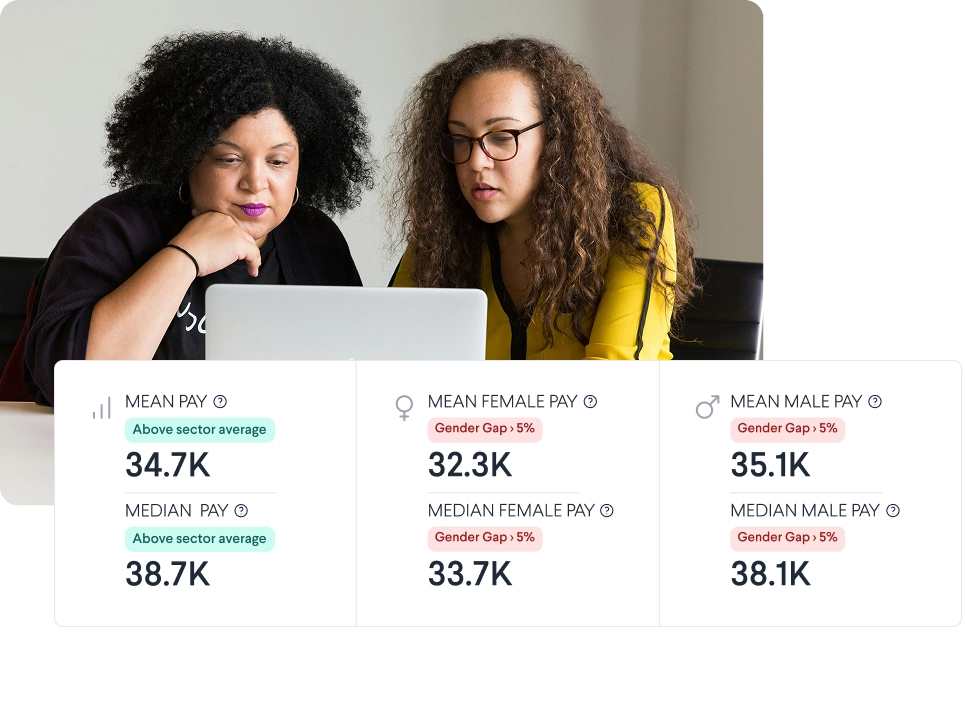
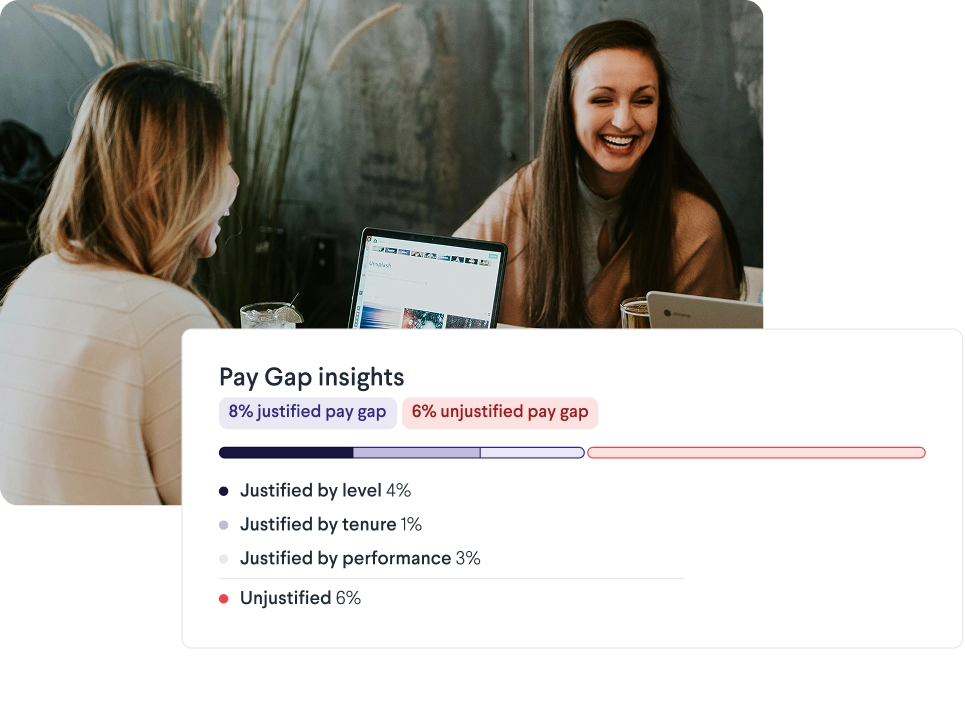
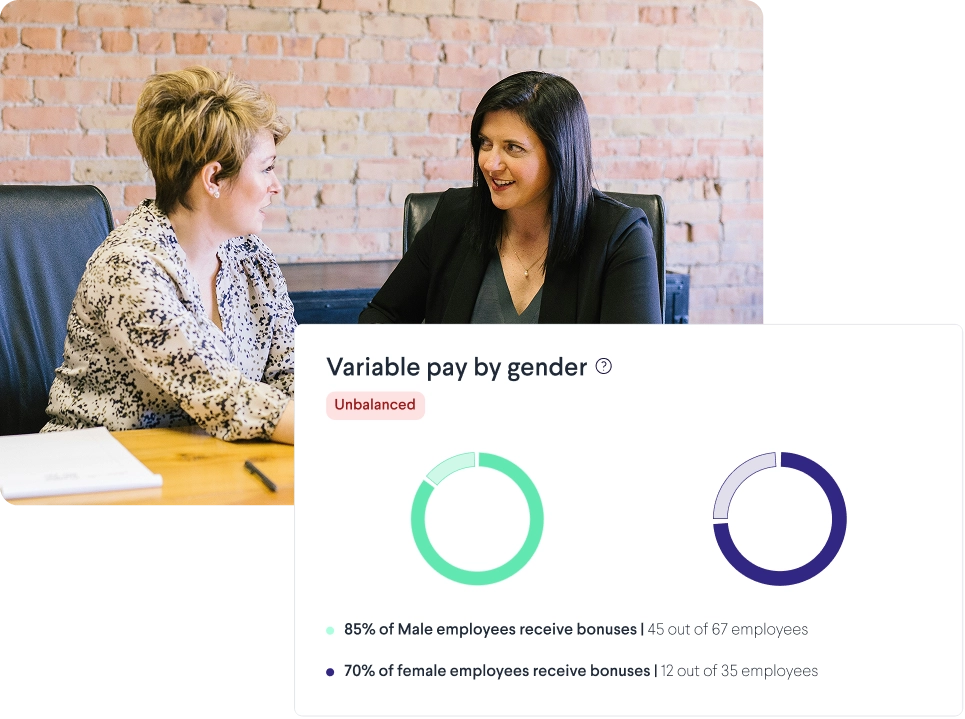
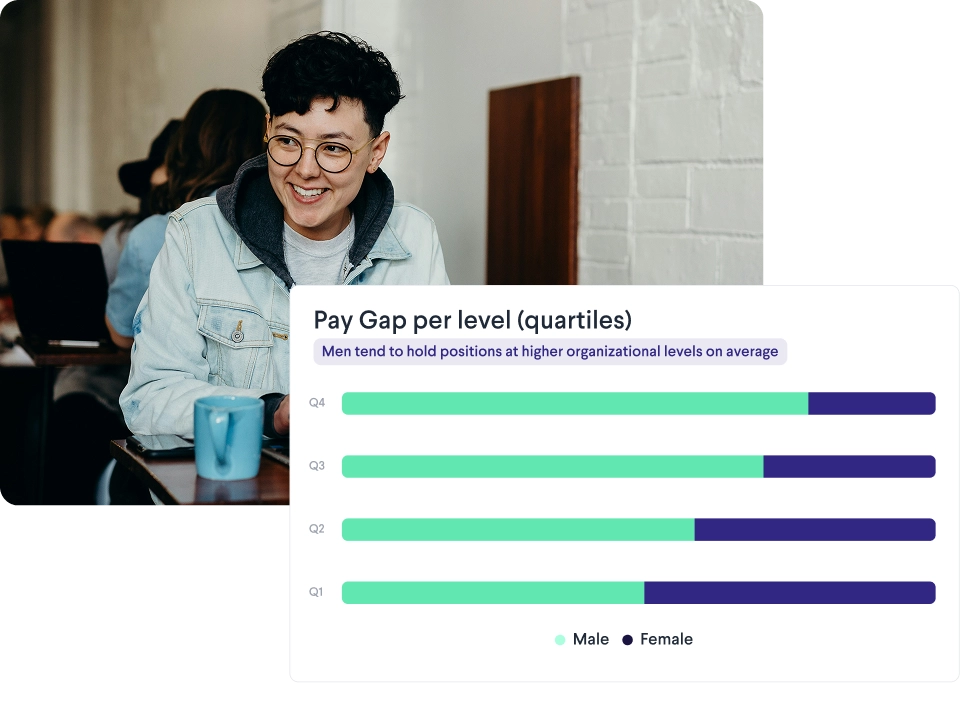
TalentUp's Internal Pay Analysis module connects your internal salary data with real-time market benchmarks. Each employee has an individual profile showing their total compensation, compa-ratio, and career progression. The platform includes advanced gender pay gap analysis — distinguishing justified from unjustified gaps — with adjustable breakdowns by level, tenure, performance, and custom labels. It also highlights structural risk factors such as variable pay distribution by gender, tenure patterns, and workforce representation by pay quartile. Compliance-ready reports can be exported in one click, with a full audit trail included.
For organisations with fewer than 500 employees, the platform is priced at €10 per employee per year. There is no setup or implementation fee. Contracts are annual — you choose each year whether to renew.
The platform is fully cloud-based, so no technical infrastructure is required on your side. Employee data can be imported via file upload or through a direct HRIS integration at no additional cost. Your HR team manages the system independently from day one.
Access can be granted to HR teams, managers, and leadership members, with configurable permissions for each user. You can also invite employees directly, allowing them to request information about their salary band.
Employees do not have open access to salary data. They can submit a request to view their salary band and a gender pay comparison within their job category, which HR reviews and approves. A full audit trail is maintained for all access and actions.
Implementation includes an onboarding session, training for your team, and a dedicated account manager. Ongoing support is available throughout your subscription.