For most of the history of hiring, salary expectations were negotiated in the dark. Candidates guessed what they might ask for based on their last salary, anecdotal conversations with peers, and whatever fragments of data they could find. Employers offered what they thought they could get away with, or what the budget allowed, and hoped it matched. The EU Pay Transparency Directive is ending that era. As employers across EU member states become required to publish salary ranges in job postings and provide candidates with benchmark data before offers are made, the conversation about salary expectations is becoming structured, transparent, and data-driven on both sides of the table.
This shift has profound implications for how HR teams and hiring managers approach salary expectation conversations during recruitment. Candidates who previously might have undersold themselves or accepted below-market offers will now arrive with data. Employers who previously relied on information asymmetry to control hiring costs will need new strategies. This article explains what the directive requires, how it changes the candidate salary expectation dynamic, and what concrete steps employers can take to meet expectations credibly and competitively.
What the EU Pay Transparency Directive Requires
The EU Pay Transparency Directive (Directive 2023/970) entered into force in June 2023 and requires transposition into national law by EU member states by June 2026. Its requirements are broad but the most relevant for candidate salary expectations are two: the obligation to publish salary ranges in job advertisements, and the right of candidates to request salary information before an interview.
Specifically, Article 5 of the directive prohibits employers from asking candidates about their salary history and requires that salary information be made available before the first interview. This is a fundamental change from the traditional model where pay discussions happen at the end of the recruitment process, after the candidate has already invested significant time and emotional energy. Under the directive, the salary range is front of mind from the moment a candidate first engages with a job posting.
Article 7 gives employees, including new hires, the right to request information about the pay levels of colleagues doing comparable work. This means that even after an offer is accepted, new employees can benchmark their own salary against peers and identify gaps that must be objectively justified. The directive does not require salary equality but it requires that differences be explicable by legitimate, non-discriminatory criteria.
How Candidate Salary Expectations Are Changing
The practical effect of the directive on candidate behaviour is already visible in markets where pay transparency has been adopted voluntarily or through earlier regulation. In the United States, pay transparency laws in states including California, Colorado, and New York have provided a preview of what happens when salary ranges are routinely published.
The research is clear: candidates use published salary ranges actively. They use them to self-screen, compare employers, and enter salary conversations with a defined anchor rather than an open-ended expectation. Candidates who previously might have accepted a first offer without negotiating are now more likely to reference the published range and push toward the upper end. Candidates who previously undersold themselves relative to their market value are now better informed.
For European candidates, the directive creates a new normal where the absence of a salary range in a job posting will itself become a competitive signal. Early adopters of transparency have already found that publishing ranges increases application volumes and reduces the time candidates spend in unproductive conversations about compensation later in the process. Those who lag on transparency will face increasing pressure from candidates who simply apply elsewhere.
According to data from the TalentUp Salary Intelligence Platform, median salaries in 2026 for common professional roles in major European cities include: Software Engineer in Berlin at €64,132, Product Manager in Brussels at €72,660, and Data Scientist in Amsterdam at €48,105. Candidates applying to roles in these cities who see published ranges significantly below these medians are now in a position to make an informed decision to look elsewhere before investing time in a process that will not meet their expectations.
Why Many Employers Are Not Ready
Despite the approaching deadline, many EU employers remain underprepared. The core challenge is not a lack of willingness to be transparent but a lack of the underlying infrastructure: documented pay bands, job levelling frameworks, and current market benchmarks for each role. Publishing a salary range requires having a salary range to publish, and producing a defensible range requires having done the benchmarking work.
Many organisations set salaries historically, through individual negotiation and internal precedent rather than through a structured framework. These organisations often have significant pay dispersion within role levels, meaning that employees doing the same job earn materially different amounts without documented justification. Publishing a range in this context is problematic: the range either needs to be wide enough to cover actual pay variation, which signals to candidates that the employer is uncertain about what the role is worth, or it needs to be narrow, which will conflict with actual pay practices when new hires compare notes with existing employees.
The remedy is to do the structural work before publishing ranges: conduct a pay equity audit, establish a job levelling framework, benchmark each level against current market data, and set pay bands that are narrow enough to be meaningful and wide enough to reflect legitimate variation by experience and performance. This is a significant undertaking but it is also the right way to run a compensation function, directive or not.
For practical guidance on how to structure this work, see our step-by-step guide on auditing salary bands and our overview of how to prepare as a complete HR team guide to the EU Pay Transparency Directive.
Setting Salary Ranges That Candidates Will Accept
When the directive requires you to publish a salary range, the quality of that range matters as much as the fact of publication. A range that is accurate, current, and competitive will attract strong candidates. A range that is below market or so wide as to be meaningless will deter them.
Anchoring to real market data is the non-negotiable foundation. Many employers set ranges based on what they paid the last person in the role, what the team budget allows, or what they heard from a recruiter eighteen months ago. None of these is a substitute for current market benchmarking. Salary markets, particularly for technology, data, and specialist professional roles, can shift by 10 to 20 percent within a year in either direction. A range based on stale data will either waste budget on overpaying or lose candidates to more informed competitors.
The recommended approach is to set the midpoint of the published range at or close to the market median for the role, level, and location, and to set the minimum and maximum at approximately the 25th and 75th market percentiles. This produces a range that is specific enough to be credible, wide enough to accommodate legitimate variation, and anchored to current external data that candidates can independently verify.
For high-demand roles where supply is tight, setting the midpoint above the market median sends a clear signal of competitiveness. For roles where you are willing to accept candidates from a broad experience range, a wider band may be appropriate, but this should be communicated explicitly in the job posting to avoid candidates at different experience levels feeling misled.
Handling the Salary Expectation Conversation Under the New Rules
Even with a published range, salary expectation conversations will continue to happen during recruitment. The difference under the directive is that these conversations are grounded in data rather than speculation, and employers cannot ask candidates about their previous salary as a reference point.

Recruiters need to be trained to have data-grounded salary conversations. The traditional approach of asking “what are your salary expectations?” as an opening gambit, and then negotiating down from whatever the candidate says, is both prohibited (in terms of asking for prior salary) and increasingly ineffective. Candidates who have seen the published range already know what the employer is willing to pay.
A more effective approach is to confirm salary alignment early by referencing the published range directly: “The role is budgeted between €X and €Y. Can you confirm that range aligns with your expectations before we proceed?” This is honest, efficient, and respectful of the candidate’s time. It also filters out misaligned candidates before the process goes further, which is a genuine efficiency gain for both parties.
When a candidate’s expectations exceed the published range, the response should be transparent. If there is no flexibility, say so clearly. If there is some flexibility within the band or through other compensation components such as bonus or benefits, explain what the total package looks like. Candidates who feel they have received an honest, complete picture of the compensation are more likely to make an informed decision rather than accepting under duress and leaving within a year.
Total Compensation as the Answer to Expectation Gaps
In markets where the cash salary on offer does not fully meet a candidate’s expectations, total compensation is often the bridge. Many candidates anchor their expectations to base salary because that has historically been the most visible component of an offer. Under the EU Pay Transparency Directive, the obligation to share pay information applies to total remuneration, not just base salary. This creates both a requirement and an opportunity: employers who offer strong non-cash components can now present their total compensation value transparently and credibly.
Pension contributions, particularly where structured as salary sacrifice arrangements, can add significant value above the base salary figure. A company contributing 8 to 10 percent of gross salary to a pension scheme is offering a materially more valuable package than a competitor offering the same base with no pension contribution. Similarly, private health insurance, generous leave allowances, equity or profit-sharing, learning and development budgets, and flexible working all have real monetary value that candidates may not spontaneously account for in their salary expectations.
Building a total compensation statement and presenting it alongside the salary offer is increasingly standard practice among leading employers. This does not change what is being offered; it ensures that the full value of the offer is communicated in a way that allows fair comparison with alternatives the candidate may be considering.
Frequently Asked Questions
What does the EU Pay Transparency Directive require employers to share about salary?
Under the EU Pay Transparency Directive, employers must include salary range information in job postings or make it available to candidates before the first interview. The directive also prohibits asking candidates about their prior salary history and requires that employers provide pay benchmark data to employees and job applicants who request it. Employers with 100 or more employees must publish annual gender pay gap reports starting from June 2027.
Can employers still negotiate salary with candidates under the directive?
Yes. The directive requires salary ranges to be published but does not fix salaries. Employers and candidates can still negotiate within the published range. However, the directive prohibits offers falling below the lower bound of the published range, and it prohibits asking candidates about their prior earnings as a basis for the offer. Negotiation must be grounded in the published range rather than the candidate’s salary history.
What should employers do if their current pay structure is not ready for transparency?
The most important step is to begin the structural work immediately: conduct a pay equity audit, establish job levelling, and benchmark each level against current market data. Many employers have discovered through this process that their internal pay structure has significant inconsistencies that need to be addressed before they can publish credible ranges. The directive timeline gives most organisations until mid-2026 for transposition, and first large-employer reporting begins in 2027, creating a window to do this work properly.
How should HR handle candidates whose salary expectations exceed the published range?
Be direct. If the expectation exceeds what the role can offer, tell the candidate clearly and early. Prolonging a process where the candidate’s expectations cannot be met wastes time for both parties and damages the employer’s reputation. If there is flexibility in total compensation through benefits, equity, or other components, present those clearly alongside the base salary range so the candidate can make an informed comparison.
How do candidates use published salary ranges during the application process?
Candidates use published ranges to self-screen before applying, to anchor their negotiating position, and to compare employers when they have multiple offers under consideration. Research from markets where pay transparency has already been implemented shows that publishing ranges increases application volume overall but reduces misaligned applications. The candidates who apply already know the range works for them, which makes the process more efficient for both sides.
What salary data should employers use to set published ranges?
Published ranges should be anchored to current, role-specific market data for the relevant location. Real-time salary intelligence platforms like TalentUp provide position-level benchmarks that reflect current market conditions rather than data collected a year or more earlier. Ranges set from stale data risk being below market, which will cost the employer candidates, or above market, which will attract volume but create budget pressure. The benchmark should be refreshed each time a role is posted, not carried forward from the previous hiring cycle.
Sources
- EUR-Lex. (2023). Directive (EU) 2023/970 on Pay Transparency. Publications Office of the European Union. Retrieved August 2026.
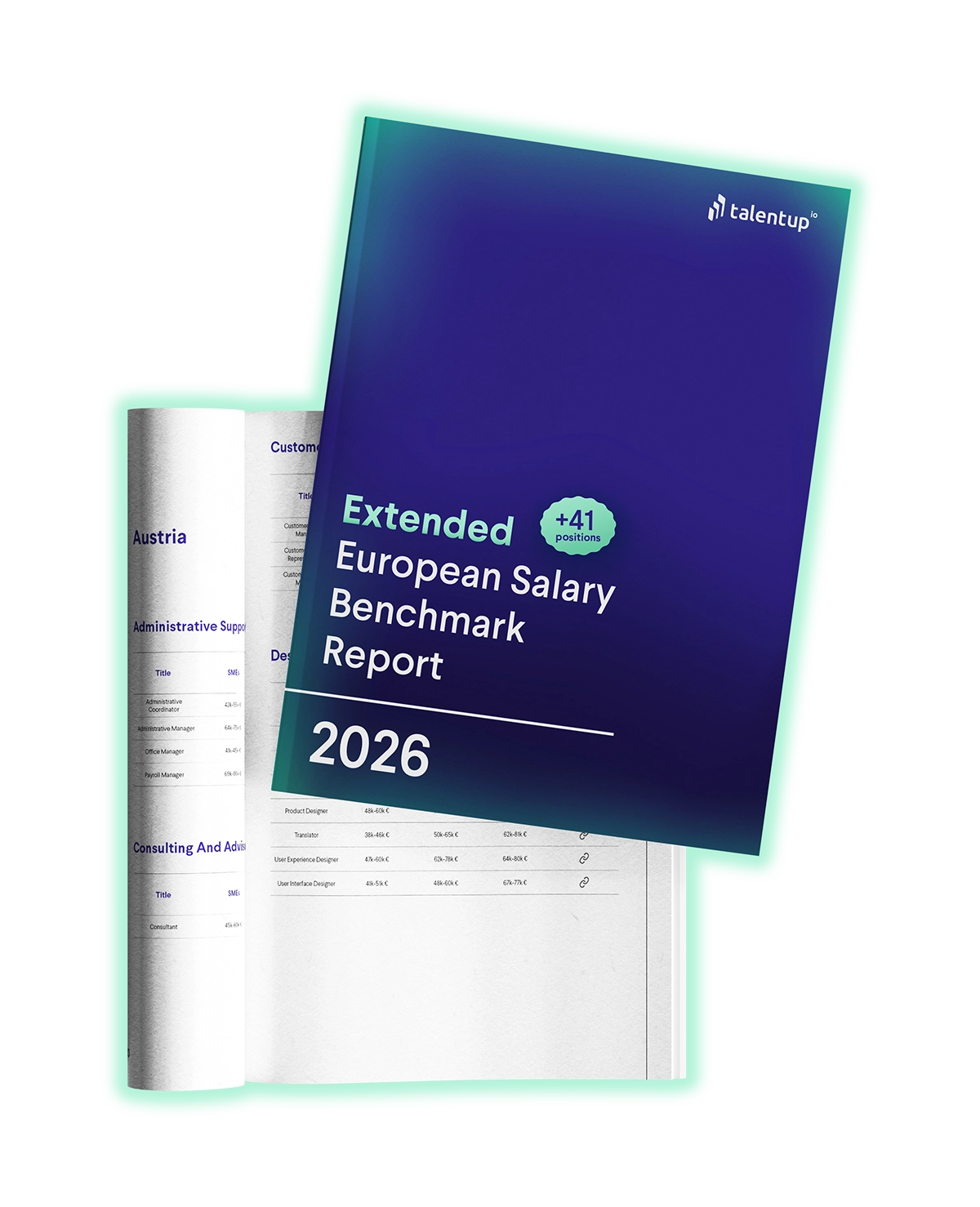
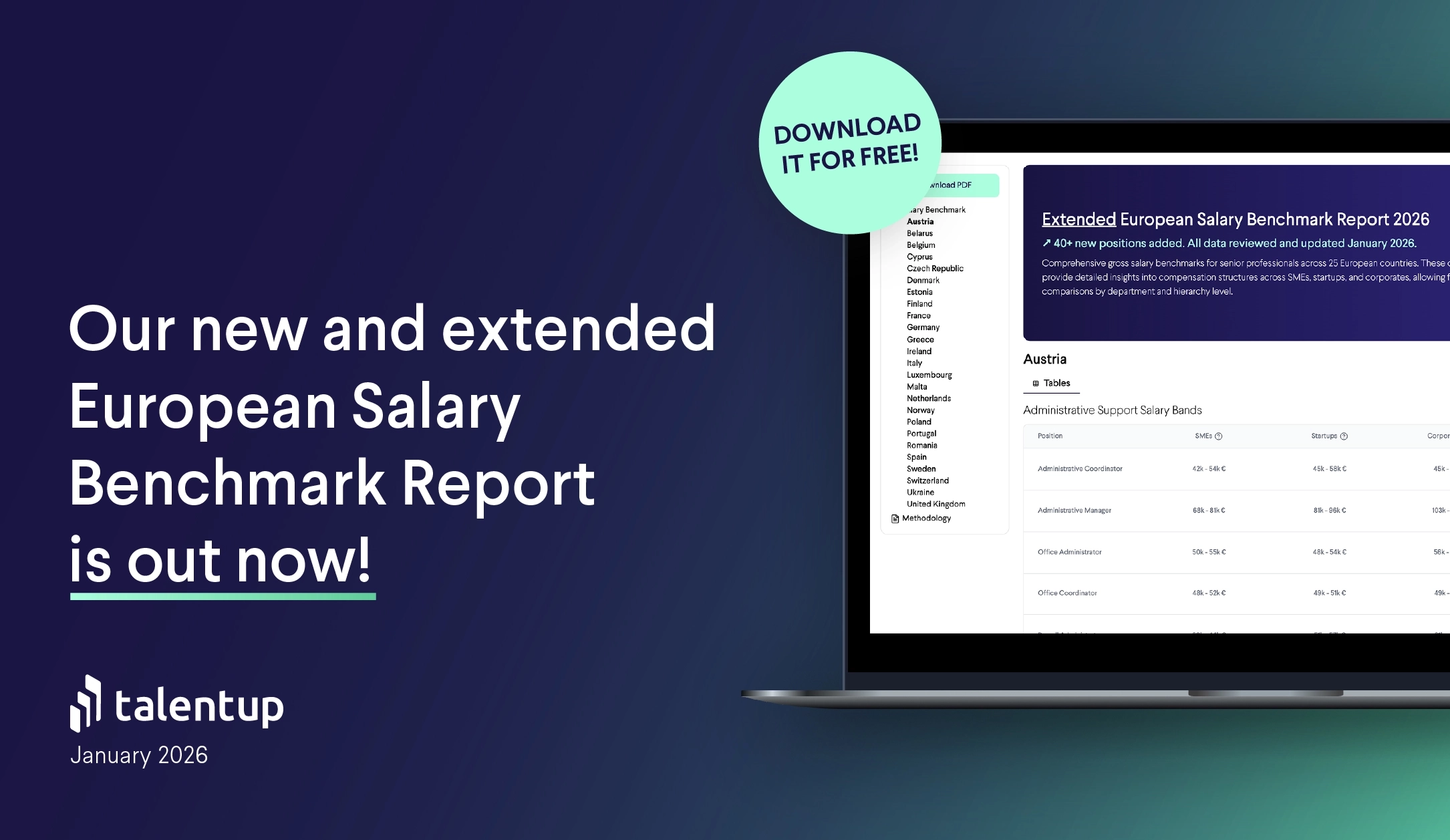
- TalentUp. (2026). European salary benchmarking report: compensation data across roles and regions. TalentUp Salary Intelligence Platform. Retrieved August 2026.
- European Commission. (2024). Equal Pay and Pay Transparency. European Commission. Retrieved August 2026.
- WorldatWork. (2023). Compensation Programs and Practices Survey. WorldatWork Total Rewards Association. Retrieved August 2026.
- Eurostat. (2025). Wages and labour costs across EU member states. European Commission Statistical Office. Retrieved August 2026.