Understanding the average salary in Paris is essential for any HR team or hiring manager operating in France. Whether you are benchmarking compensation for a new hire, reviewing your pay structure against the local market, or evaluating whether your existing salary bands remain competitive, having accurate, role-specific data makes the difference between decisions grounded in evidence and decisions made on guesswork. This article draws on live salary data from the TalentUp Salary Platform to give you a clear picture of what employers in Paris are paying across six key professional roles.
Salary benchmarking is not a one-time exercise. Markets move, competition for talent shifts, and inflation cycles alter the real value of pay packages. Salary comparison: Germany vs. France is a topic that compensation and HR professionals revisit regularly, and the availability of real-time, market-based data is what separates a reliable benchmark from an outdated survey. The TalentUp platform provides continuously updated data so that the figures you see here reflect the actual state of the Paris professional labour market.
The Paris labour market context
Paris is France’s dominant economic centre and accounts for a disproportionate share of national GDP, employment, and corporate headquarters. The city hosts the European or global headquarters of major luxury goods groups, financial services firms, technology companies, and professional services organisations. As in most large European capitals, there is a substantial pay premium for working in Paris relative to other French cities, and compensation surveys in France typically present Paris and provincial data separately.
For HR and compensation professionals, the implication is that salary benchmarks for Paris should not be derived from general national averages alone. Role-specific, city-level data is necessary to build compensation structures that are accurate and defensible. Salary comparison: Spain vs. France is an important consideration for organisations with employees in multiple locations, and Paris is a case where local calibration of pay is particularly relevant.
Average salary in Paris: key figures by role
TalentUp data shows median annual salaries in Paris at: Software Engineer at €63,034, Data Engineer at €57,469, HR Business Partner at €72,757, Financial Controller at €55,246, Marketing Manager at €87,363, Sales Engineer at €71,460. All figures are expressed in EUR and reflect median compensation at the time of data collection.
The figures above are median values from the TalentUp Salary Platform and represent the midpoint of the salary distribution for each role in Paris. The median is a more useful reference than the mean for most compensation decisions because it is not distorted by outlier packages at the very top or bottom of the market. Half of employers in the sample pay below these medians and half pay above, giving you a clear anchor for positioning your own pay ranges.
Software Engineer salary in Paris
The median annual salary for a Software Engineer in Paris is €63,034 according to TalentUp data. Software Engineers in Paris work across a range of employer types and technology stacks, and seniority has a strong effect on where individual salaries land relative to this median. Junior engineers with fewer than three years of experience typically fall well below, while senior engineers at established technology companies or large multinationals can earn significantly above this benchmark. The demand for software engineering talent in Paris has been consistent and the market for experienced engineers remains competitive.
Data Engineer salary in Paris
Data Engineers in Paris earn a median annual salary of €57,469, reflecting strong demand for professionals who can build and maintain data pipelines, integrate disparate data sources, and support the analytical functions of data-driven organisations. The Data Engineer role is consistently one of the fastest-growing in professional employment across most markets, and Paris follows this trend. Professionals with expertise in cloud-based data platforms, dbt, Spark, or modern data warehousing tools typically command salaries above this median, particularly at companies where data infrastructure is a strategic priority.
HR Business Partner salary in Paris
HR Business Partners in Paris earn a median annual salary of €72,757. The HRBP role spans a wide range of responsibilities, from talent acquisition support and workforce planning to employee relations and compensation benchmarking. In Paris, the spread of salaries for this role is wide: HR Business Partners at small or mid-market domestic employers typically earn below this median, while those at large multinationals or organisations with sophisticated people operations functions often earn considerably above it. Specialisation in compensation and benefits or in organisational design tends to attract a premium within the HRBP category.
Financial Controller salary in Paris
The median annual salary for a Financial Controller in Paris is €55,246. Financial Controllers hold responsibility for the integrity of financial reporting, internal controls, and management accounting processes. In Paris, this role is well-compensated relative to other financial functions, reflecting the seniority and accountability the position carries. Professionals with a qualified accountancy designation (ACCA, CIMA, or equivalent) and several years of post-qualification experience typically earn at or above this median. The employer sector and company size are significant variables, with larger organisations and financial services firms typically paying above the midpoint.
Marketing Manager salary in Paris
Marketing Managers in Paris earn a median annual salary of €87,363, one of the higher figures in the TalentUp dataset for this market. The Marketing Manager role in Paris typically encompasses brand management, campaign planning, and in many organisations, digital and performance marketing oversight. Variable pay components, including performance bonuses tied to commercial metrics, are common in this role and can add meaningfully to the total package above the base salary median shown here. Professionals with demonstrated track records of driving measurable revenue or brand outcomes are in the strongest negotiating position.

Sales Engineer salary in Paris
Sales Engineers in Paris earn a median annual salary of €71,460 according to TalentUp. The Sales Engineer role bridges technical expertise and commercial acumen, supporting sales teams in winning complex business-to-business deals by demonstrating product capabilities and designing technical solutions for prospective customers. Variable compensation in the form of commissions or performance bonuses is nearly universal in this role, which means the base salary median understates total cash compensation for high performers. Sales Engineers with deep expertise in a specific technology domain or vertical market can command premiums well above this median.
What shapes salaries in Paris
The concentration of luxury goods and fashion companies in Paris drives exceptional compensation for Marketing Managers relative to French benchmarks. HR Business Partners benefit from the density of large, structured organisations that maintain sophisticated people operations functions. Financial Controllers in Paris earn well but trail the Germany average, reflecting structural differences between the French and German corporate landscapes. The technology scene has grown markedly since the Grande École network began producing more startup founders, pushing Software Engineer salaries higher.
Seniority remains one of the most consistent drivers of pay across all roles in Paris. A professional with ten years of relevant experience can realistically expect to earn significantly above the median shown here, while an early-career hire with fewer than three years of experience would typically land below it. Company size also matters: larger organisations tend to run more structured compensation programmes, often producing higher pay at mid-to-senior levels, while smaller companies may offer equity or flexibility to offset a lower base.
For organisations with operations in the EU, the incoming Pay Transparency Directive adds a compliance dimension to compensation planning in Paris. The directive requires employers to publish salary ranges in job postings, provide pay information to employees on request, and report gender pay gaps annually. Having market-referenced salary bands in place before the compliance deadline makes it substantially easier to meet these requirements without scrambling to justify pay decisions after the fact.
How to use TalentUp salary data for benchmarking
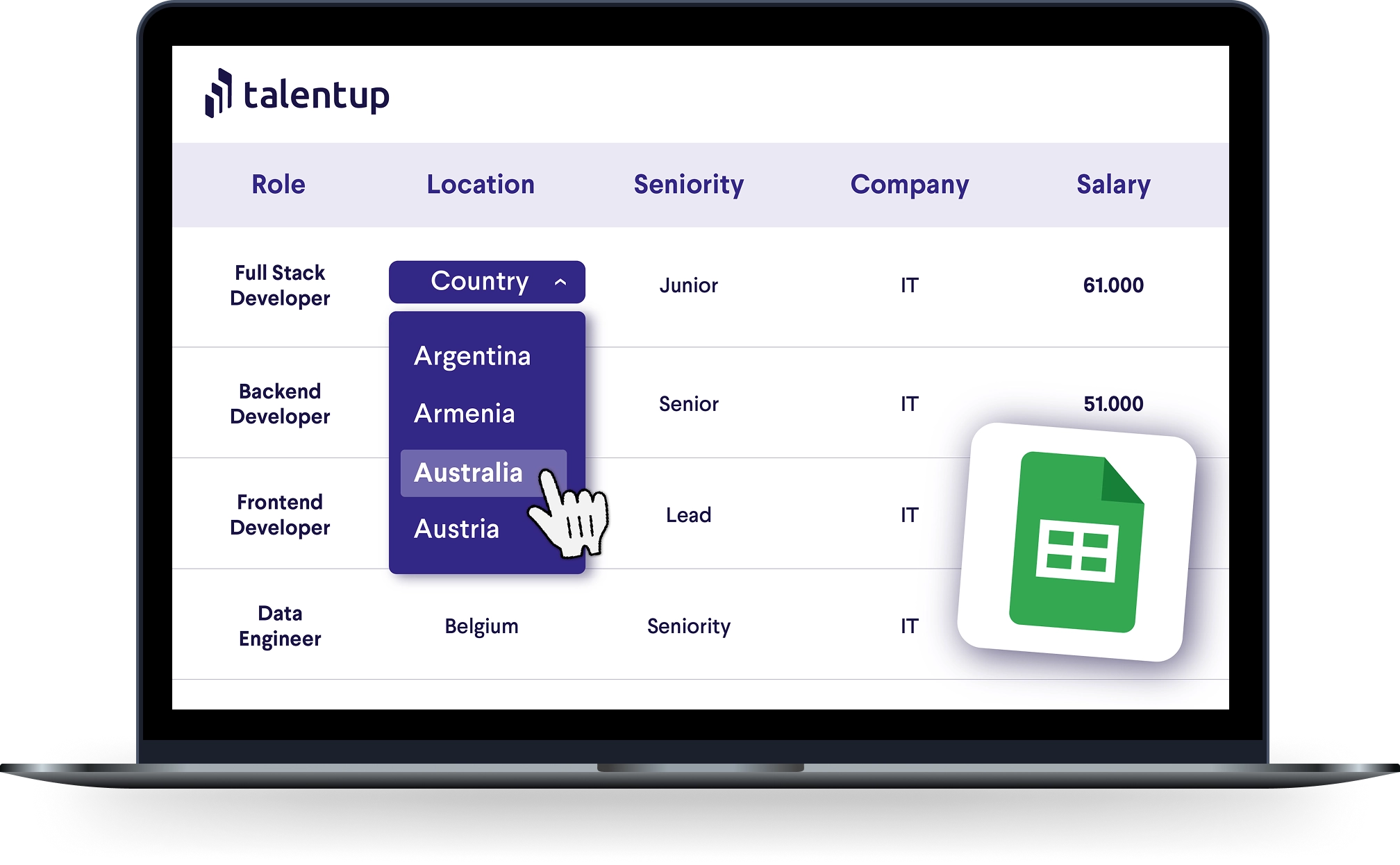
The TalentUp Salary Platform lets HR and compensation teams query salary data by role, location, seniority level, and company size. Rather than relying on annual printed survey reports that are often six to twelve months out of date by the time they reach you, TalentUp provides continuously refreshed benchmarks drawn from a live dataset of actual pay records. For Paris, this means you can see how salaries for a specific role are moving in real time, which is particularly valuable in fast-changing markets or when you are competing for candidates who have multiple offers in flight.
Compensation benchmarking with TalentUp works best as a structured process: identify the roles you need to benchmark, set your peer group (industry sector and company size), choose your market positioning target (for example, the 50th or 75th percentile), and then build or update your salary bands from there. The platform supports this workflow directly and lets you document the methodology behind your pay ranges, which is increasingly important as pay transparency requirements expand.
For teams that are new to formal compensation benchmarking, the TalentUp platform includes guidance on how to interpret percentile data, build salary bands, and communicate pay decisions to managers and employees. The goal is to move from reactive, case-by-case salary decisions to a proactive framework that is consistently applied and regularly updated. That shift reduces time spent on individual negotiations, improves pay equity outcomes, and gives employees and candidates confidence that your pay ranges are based on real market data.
Conclusion
The TalentUp data presented here gives HR and compensation professionals a reliable, role-specific reference for average salaries in Paris. The figures reflect median annual compensation across six professional roles and are expressed in EUR to enable straightforward comparison across markets. For organisations hiring or managing compensation in Paris, these benchmarks should be used as a starting point for building salary bands, not as a fixed ceiling or floor. Market context, seniority, company size, and specific role requirements will all influence where individual packages land within or around these medians.
Access current salary data for Paris and hundreds of other locations through the TalentUp Salary Platform. The platform provides the depth of role-specific, percentile-based data that compensation teams need to make confident, evidence-based pay decisions.
Sources
- TalentUp. (2026). European salary benchmarking report: compensation data across roles and regions. TalentUp Salary Intelligence Platform. Retrieved August 2026.
- WorldatWork. (2023). Compensation Programs and Practices Survey. WorldatWork Total Rewards Association. Retrieved August 2026.
- SHRM. (2024). Developing a compensation philosophy and salary structure. Society for Human Resource Management. Retrieved August 2026.
- Eurostat. (2025). Wages and labour costs across EU member states. European Commission Statistical Office. Retrieved August 2026.
- ILO. (2024). Global Wage Report: wages, labour market trends and wage inequality. International Labour Organization. Retrieved August 2026.