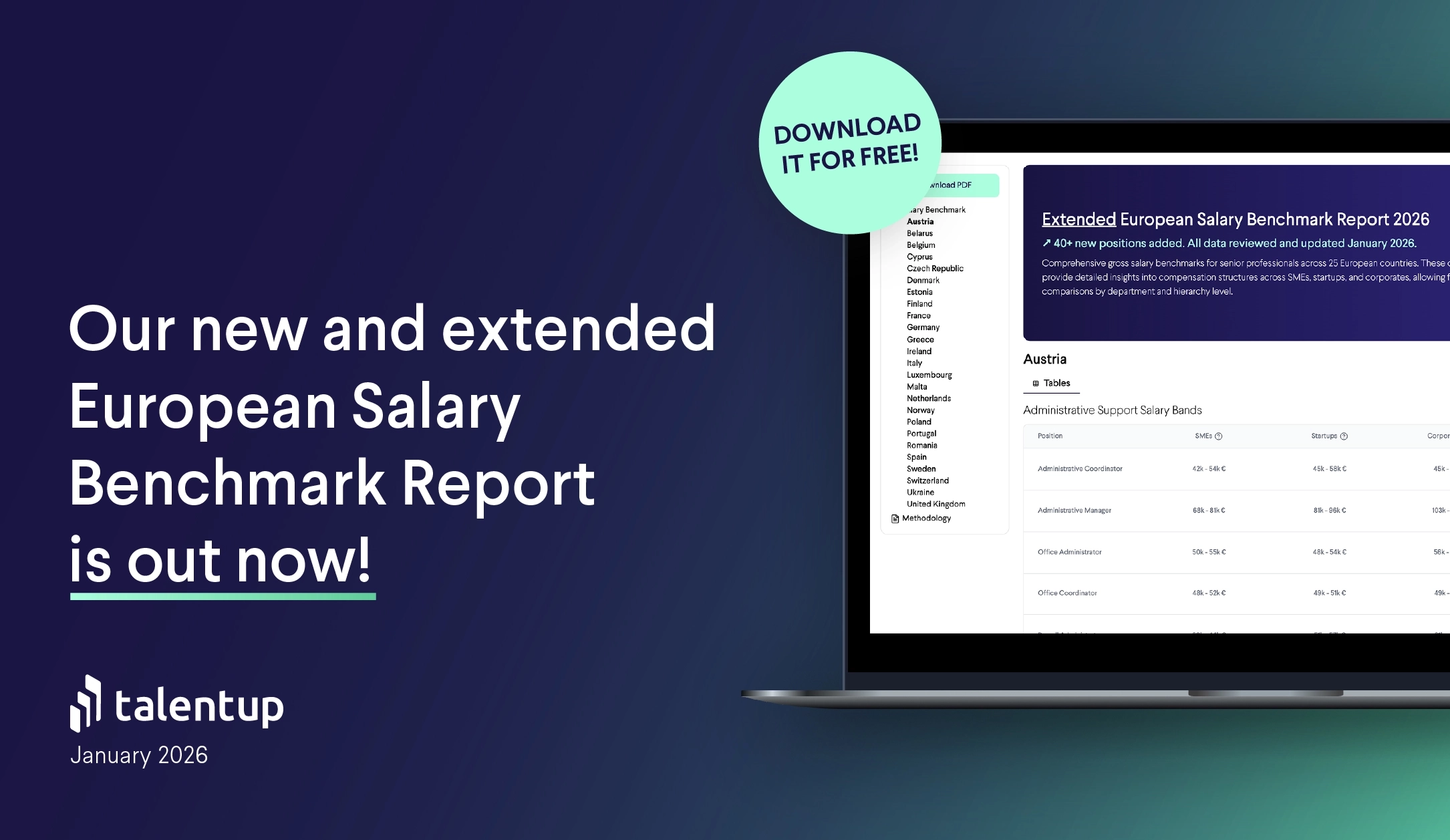
Ready to benchmark salaries with real European market data? The TalentUp Salary Platform gives HR and C&B professionals instant access to salary benchmarks across roles, seniority levels, and countries.
According to TalentUp data, organisations that benchmark compensation systematically against external market rates are significantly more likely to report strong talent retention and employee trust scores. HR and compensation teams can use the TalentUp Salary Platform to access live, role-specific salary benchmarks across European markets and build the evidence base needed for credible, transparent pay decisions.
When internal benchmarking creates blind spots
Internal benchmarking has a structural limitation that no amount of rigour can overcome: it is anchored to the organisation’s own historical pay decisions, which are themselves the product of past market conditions, negotiation outcomes, and budget constraints that may no longer be relevant. If the organisation systematically underpaid for a particular role in 2021 and 2022, internal benchmarking will reproduce and entrench that underpayment in 2024 and 2025. The benchmark becomes a mirror of past decisions rather than a guide to current market reality. This is particularly problematic for roles where external demand has shifted rapidly, such as those requiring AI literacy, advanced data analysis, or specialised compliance expertise in regulatory areas like the EU Pay Transparency Directive.
The internal promotion pipeline creates an additional distortion. Employees who are promoted into new roles often receive pay increases of 10 to 20 percent from their previous salary, which anchors their new compensation to their old one rather than to the market rate for the role they now occupy. Over time, this creates a situation where the compensation for a given role reflects the career history of the individual who happens to hold it rather than the value the organisation places on that role relative to the market. External benchmarking corrects for this by providing a role-based reference point that is independent of how the current incumbent arrived at their position.
The case for combining both approaches
The most sophisticated compensation programmes use internal and external benchmarking not as alternatives but as complementary lenses that together provide a more complete picture of compensation health than either can provide alone. Internal benchmarking reveals the relative value the organisation places on different roles and the equity of pay distribution across the workforce. External benchmarking reveals whether the organisation’s overall pay positioning is competitive in the markets it is recruiting from. Together, they identify the roles where the internal equity structure and the external competitive position are well aligned, and the roles where they diverge in ways that create either retention risk or budget inefficiency.
According to TalentUp data, organisations that benchmark both internally and externally on an annual basis report significantly higher confidence in their ability to make accurate offer decisions and significantly lower rates of offer rejection on compensation grounds than those that rely on a single approach. The investment in maintaining both data sets is substantial, but the return in terms of reduced failed offers, lower attrition among high-performing employees, and better calibrated merit budget allocation makes the combined approach financially compelling for any organisation with significant professional workforce costs.
Choosing the right external benchmarking peer group
The value of external benchmarking depends critically on the quality of the peer group used as the reference point. Benchmarking against the wrong peer group produces data that is precise but misleading, which can be more damaging than no data at all because it creates false confidence in pay decisions that are actually misaligned with the market that is competing for the same talent. Selecting the right benchmarking peer group is one of the most consequential and most frequently mishandled elements of compensation management. The peer group should reflect the actual competitive landscape for each role, which means it should include the organisations that candidates in that role are most likely to be evaluating as alternative employers, not the organisations that are most similar to the company in industry or size if those organisations do not compete for the same talent.
Geographic precision matters as much as industry and size calibration. A company benchmarking engineering salaries in Amsterdam against European averages that include lower-cost markets will systematically underestimate the competitive rate for that role in that location. City-level benchmarking data, available through the TalentUp Salary Platform, provides the location-specific granularity needed to ensure that salary ranges reflect what candidates in a specific labour market are actually receiving from competing employers rather than what employees in a different market are receiving for nominally similar work.

Operationalising the benchmarking cycle
A benchmarking process that is theoretically sound but operationally cumbersome will not be used consistently, and inconsistent application creates the pay inequities that the process was designed to prevent. The practical challenge for most HR and compensation teams is integrating benchmarking into the annual salary review, promotion, and hiring workflows in a way that is rigorous enough to produce reliable data but efficient enough to be sustainable with the resources available. A structured salary band audit conducted annually provides the systematic review that connects benchmarking data to the actual salary bands that govern pay decisions, ensuring that the external data is translated into operational guidance that hiring managers and HR business partners can use without requiring a custom benchmarking exercise for every decision.
The frequency of the benchmarking cycle should match the pace of change in the relevant labour markets. For roles in fast-moving fields where compensation is rising rapidly, annual benchmarking may be insufficient; quarterly or semi-annual updates may be needed to prevent salary bands from falling materially behind the market within the review cycle. For roles in more stable markets, annual benchmarking combined with a mid-year pulse check may be sufficient. Organisations that treat benchmarking as a once-a-year exercise regardless of market dynamics risk making decisions based on data that is twelve to eighteen months old in markets that have moved significantly since the data was collected. The goal is a benchmarking cadence that keeps pay decisions anchored to the market as it currently exists rather than the market as it was when the last survey was fielded.
Sources
- TalentUp. (2026). European salary benchmarking report: compensation data across roles and regions. TalentUp Salary Intelligence Platform. Retrieved August 2026.
- WorldatWork. (2023). Compensation Programs and Practices Survey. WorldatWork Total Rewards Association. Retrieved August 2026.
- SHRM. (2024). Developing a compensation philosophy and salary structure. Society for Human Resource Management. Retrieved August 2026.
- Eurostat. (2025). Wages and labour costs across EU member states. European Commission Statistical Office. Retrieved August 2026.
- ILO. (2024). Global Wage Report: wages, labour market trends and wage inequality. International Labour Organization. Retrieved August 2026.
Salary benchmarking is most effective when it is treated as a continuous process rather than an annual snapshot. Markets shift, new roles emerge, and inflation erodes purchasing power in ways that a once-a-year review simply cannot capture. Organisations that build live benchmarking into their quarterly compensation reviews are consistently better placed to retain key talent, make competitive offers, and identify pay compression before it becomes a flight-risk problem. Platforms like TalentUp give HR and compensation teams access to current, role-specific salary data across European markets, turning benchmarking from a slow research task into a real-time capability.
Effective salary benchmarking requires more than pulling a number from a survey report. It demands matching roles accurately by scope, seniority, sector, and geography, then interpreting the data in the context of your organisation’s compensation philosophy and budget constraints. When done rigorously, benchmarking reduces the risk of both overpaying in low-demand markets and losing candidates in highly competitive ones. It also provides the evidence base HR teams need to build credible business cases for compensation adjustments when presenting to finance and leadership.
The most common benchmarking pitfall is comparing job titles rather than job content. A senior engineer at a forty-person startup operates in a fundamentally different scope than a senior engineer at a multinational, yet both share a title. Robust benchmarking methodologies account for role complexity, management responsibility, and the market segment being targeted, ensuring that compensation decisions reflect genuine market position rather than superficial title matching. This level of rigour is what separates compensation programmes that attract and retain top talent from those that perpetually lose offers to competitors.
For international organisations, salary benchmarking adds an additional layer of complexity: purchasing power, tax environments, and local labour market dynamics vary substantially across countries. A compensation package that is highly competitive in Warsaw may be mediocre in Amsterdam, and vice versa. Multinational HR teams need country-level data, not just regional averages, to make credible and fair offers. TalentUp’s European salary data covers this granularity, giving global compensation teams the local market intelligence they need to build consistent yet locally calibrated pay structures.
Effective talent management requires a holistic approach that considers not just compensation levels but the full employee experience, from the recruitment process through onboarding, development, recognition, and eventual progression. Organisations that think in terms of total rewards, career trajectory, and workplace culture alongside base salary are consistently better at attracting candidates who match their values and retaining the employees who drive their best outcomes. Compensation is the foundation, but it is rarely sufficient on its own to explain why people choose to join, stay, or leave.