Cookie Settings

We use cookies to improve your experience and for marketing. Visit our Cookies Policy to learn more.

Insights

European Job Market by Sector in Early 2026: Opportunities and Trends

TalentUp Team 04/10/2025

Salary Finder: Your Global Pay Guide 🚀

Search Salaries for Any Role, Anywhere in the World with our Salary Benchmarking Platform

Table of Contents
  1. European Job Market in Early 2026: A Sector-by-Sector Breakdown
  2. Technology and IT
  3. Sales and Commercial Roles
  4. Finance and Professional Services
  5. Operations and Logistics
  6. Key Takeaways for 2026
  7. Country-by-Country Breakdown: Where European Hiring Is Hottest in 2026
  8. Cross-Border Hiring and Remote Work in Europe
  9. What Job Seekers Should Know About European Markets in 2026
  10. Final Thoughts: European Markets in 2026
Image Description

European Job Market in Early 2026: A Sector-by-Sector Breakdown

The European job market in early 2026 looks meaningfully different from even 12 months ago. After a period of correction and hiring caution in 2024–2025, several sectors are seeing a strong rebound in open positions. Others continue to face structural headwinds. Here is what the data shows.

Technology and IT

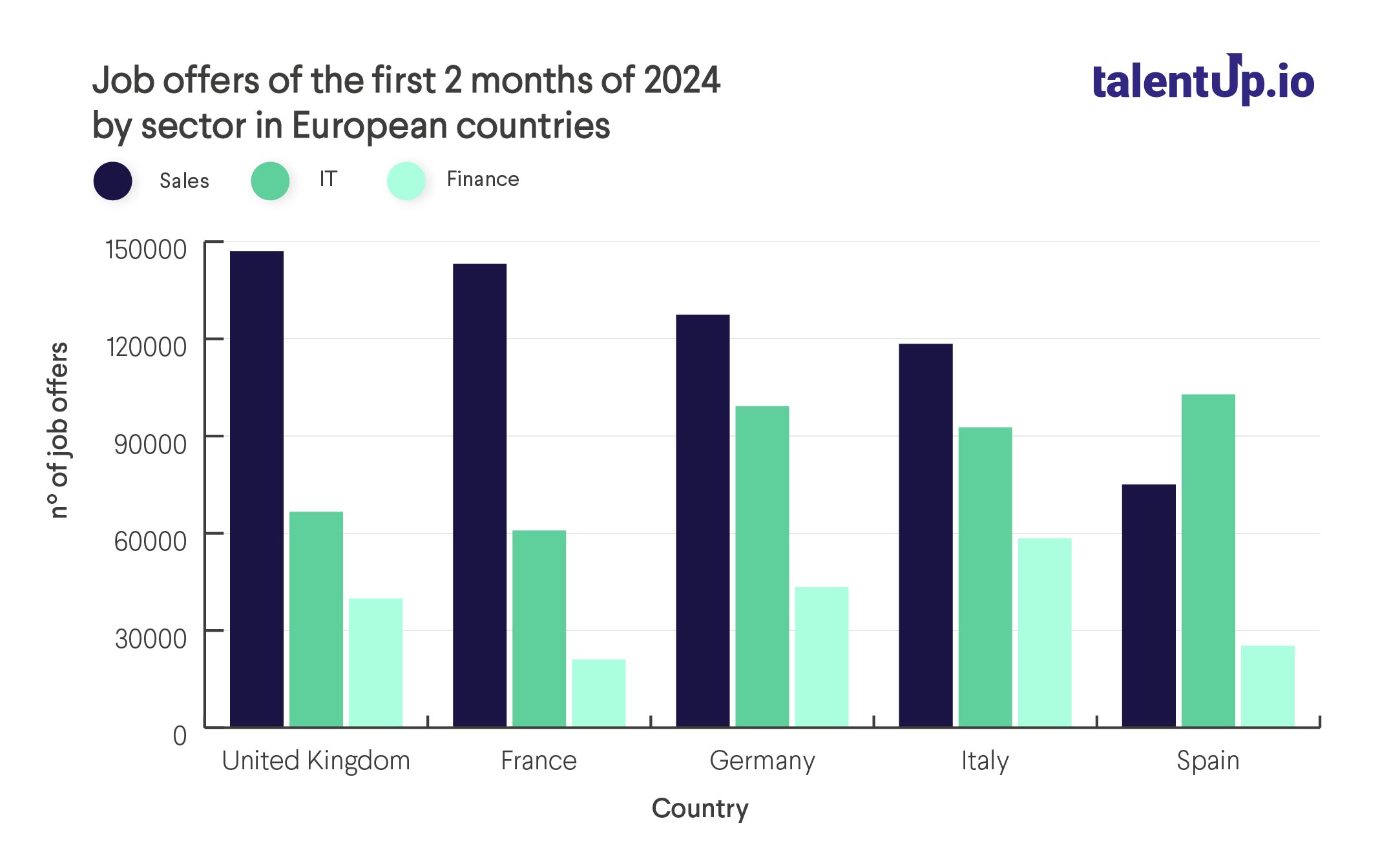
Tech hiring is recovering — but selectively. AI/ML, cybersecurity, and cloud infrastructure roles are in high demand across all major European markets. AI is fuelling a reported 27% tech hiring surge across Europe, even as junior and generalist roles remain constrained. Spain’s tech market is particularly active, with IT roles growing fastest in Madrid and Barcelona as international companies continue to establish European hubs there.

The UK and Germany remain the largest tech hiring markets by volume, but Portugal, the Netherlands, and Poland are seeing the fastest growth rates, driven by a combination of competitive salaries and improving digital infrastructure.

Sales and Commercial Roles

Sales hiring has rebounded strongly in early 2026. After two years of belt-tightening, companies are reinvesting in revenue-generating roles. Demand for sales professionals is particularly high in B2B SaaS, financial services, and medtech. Across European markets, companies with the highest salary offers in commercial roles are winning the best candidates — the days of selling a role on mission alone have passed.

Finance and Professional Services

The UK, Germany, and Italy remain the strongest markets for finance professionals. Demand is concentrated in FP&A, risk and compliance (driven by regulatory changes), and fintech-adjacent roles. ESG reporting specialists are emerging as a new high-demand category as EU sustainability reporting requirements come into full effect.

Operations and Logistics

Supply chain disruptions of the early 2020s have permanently elevated the strategic importance of operations and logistics talent. In early 2026, demand for supply chain managers, procurement specialists, and logistics technology professionals is steady across all major markets. The green logistics transition — driven by EU emissions targets — is creating new specialisms around sustainable supply chains and last-mile delivery optimisation.

Key Takeaways for 2026

Talent competition remains intense in specialised roles. Companies that move quickly, offer transparent salary ranges, and communicate total compensation clearly are winning. Platforms like TalentUp.io allow HR teams and candidates alike to track salary benchmarks by sector, role, and geography — a practical tool for staying ahead of market movements throughout the year.

Country-by-Country Breakdown: Where European Hiring Is Hottest in 2026

European job markets are not monolithic — hiring dynamics, salary levels, and in-demand sectors vary considerably by country. Here is a country-by-country view of where opportunities are most active in 2026.

Germany

Germany remains Europe’s largest job market by volume, with particularly strong demand in engineering, manufacturing technology, and finance. The automotive transition — as Germany’s largest industrial sector navigates the shift to electric vehicles — is creating significant demand for software, electronics, and battery technology engineers. Berlin continues to be a major tech hub, with a thriving startup ecosystem and growing presence of international technology companies.

United Kingdom

The UK remains a major European hiring market despite Brexit-related changes to talent mobility. London is the dominant hub for finance, professional services, and technology, with particularly strong demand in fintech, cybersecurity, and AI. Post-Brexit visa requirements have made international hiring more complex, but skilled worker visa pathways remain open and many companies have adapted their processes accordingly.

Netherlands

The Netherlands punches above its weight as a European hiring market, driven by its role as a logistics hub, financial centre (Amsterdam), and high-tech cluster (Eindhoven). ASML’s continued growth, combined with the presence of major multinationals and a world-class university system, makes the Netherlands one of the most dynamic labour markets in Europe. Average gross salaries reached €53,436 per year in 2026, with CAO wages rising 4.1%.

Spain

Spain’s tech market is among the fastest-growing in Europe in 2026. Madrid and Barcelona are seeing rapid expansion in software development, digital marketing, and fintech roles, driven by a combination of lower operating costs compared to Northern Europe and a growing pool of technical talent. International companies are increasingly choosing Spain for European technology hubs, attracted by quality of life, competitive salaries, and improving digital infrastructure.

Poland

Poland is one of the most active technology hiring markets in Central and Eastern Europe. Warsaw and Kraków are major centres for software engineering, IT outsourcing, and business services. Polish developer salaries remain competitive with Western Europe on a purchasing-power-adjusted basis, making Poland attractive for companies looking to build high-quality technology teams at sustainable cost.

Portugal

Portugal has emerged as one of the most talked-about European tech destinations in recent years, attracting both remote workers and company expansions with its combination of quality of life, relatively affordable costs, and strong English proficiency. Lisbon and Porto are growing tech hubs, and the Digital Nomad Visa has made Portugal accessible to international talent. However, local talent shortages mean that many positions are filled with international hires, and salary expectations are adjusting upward.

Cross-Border Hiring and Remote Work in Europe

One of the most significant structural changes in the European job market is the normalisation of cross-border remote work. Companies in high-cost markets like the Netherlands, UK, and Germany are increasingly recruiting from across the EU — accessing talent pools in Spain, Poland, Portugal, and Romania while offering salaries competitive within those local markets.

This creates complexity around employment law, social security contributions, and tax — each country has its own requirements, and employing someone remotely in another EU member state requires careful legal structuring. Employer of Record (EOR) services have grown significantly to address this need, allowing companies to hire across borders without establishing local legal entities.

For HR teams navigating this complexity, accurate salary data by country is essential. TalentUp’s Salary Platform provides role-specific benchmarks across European markets, enabling cross-border hiring decisions to be made with confidence and consistency.

What Job Seekers Should Know About European Markets in 2026

For professionals considering a move or actively job searching in Europe in 2026, understanding the market dynamics in your target location and sector is essential for setting realistic expectations and making a competitive impression.

Research Before You Apply

Understanding the salary range for your target role in your target market — not just in general but at the specific seniority and experience level you represent — is the foundation of an effective job search in 2026. With the EU Pay Transparency Directive driving more employers to publish pay ranges in job listings, this research is becoming easier. Take advantage of published ranges, combine them with benchmarking data, and enter salary conversations with genuine market knowledge rather than guesswork.

Understand What You Are Comparing

When evaluating offers across European markets, be careful to compare total compensation including pension, equity, bonus, and benefits — not just base salary. A base salary in Amsterdam may look lower than an equivalent role in Zurich, but when the 30% ruling, pension contributions, and standard benefits are included, the total package may be more competitive than the headline number suggests. Similarly, the purchasing-power reality of different cities varies dramatically — €80,000 in Lisbon goes considerably further than €80,000 in Amsterdam or Zurich.

Skills Are Portable; Leverage Yours

One of the structural realities of the 2026 European job market is that genuinely scarce skills command premiums that are relatively consistent across borders. An AI engineer, a senior cybersecurity specialist, or an ESG finance professional with strong credentials can negotiate from a position of market leverage in virtually every Western European market. Understanding the cross-border value of your skill set — and being willing to consider markets where it commands the highest return — is a genuine career development advantage in the current environment.

Employer Brand Matters, But So Does Your Research

In 2026, candidates have more tools than ever to research potential employers before accepting an offer. Glassdoor, LinkedIn reviews, and professional network conversations all provide intelligence about employer culture, management quality, career progression pathways, and the actual experience of working at a company versus the marketed version. Using these tools systematically — not just to check salary data but to validate the full employment proposition — leads to better decisions and lower regret.

For salary benchmarking across European markets, TalentUp’s Salary Platform provides role-specific, location-specific data that gives both job seekers and employers the intelligence to have better, more productive compensation conversations throughout the hiring process.

Final Thoughts: European Markets in 2026

The European job market in 2026 is characterised by significant variation — across sectors, across countries, and across experience levels — but the underlying dynamics are consistent: demand for specialist digital, sustainability, and analytical skills continues to outpace supply, while the entry-level market remains constrained. For HR professionals and job seekers alike, understanding these dynamics with precision is the foundation of effective decision-making. Real-time salary intelligence from platforms like TalentUp Salary Platform ensures those decisions are grounded in what the market looks like today, not 12 months ago.

Benchmark Salaries with TalentUp

Stay ahead of market movements with real-time salary data. TalentUp Salary Platform gives HR teams and recruiters live, role-specific compensation benchmarks across Europe — so every offer you make is backed by current data.

Further reading: European salary gap by sector and % of remote offers by year and sector in European countries.

Sources

Taleva — European Hiring Trends 2026 — Sector-by-sector hiring data across Europe
Morgan McKinley Salary Guide 2026 — Salary benchmarks by country and sector

Subscribe to our newsletter and stay updated

No spam, unsubscribe at any time