Cookie Settings

We use cookies to improve your experience and for marketing. Visit our Cookies Policy to learn more.

Compensation

Annual Salary Reviews for 2025-2026: A Deep Dive into TalentUp Salary Platform

Salary Finder: Your Global Pay Guide 🚀

Search Salaries for Any Role, Anywhere in the World with our Salary Benchmarking Platform

Annual Salary Reviews: Why They Matter More Than Ever in 2025–2026

Annual salary reviews have always been a cornerstone of HR management. But in 2025–2026, with wage growth running at 4–5% across much of Europe, EU pay transparency regulations entering enforcement, and employees arriving at reviews armed with their own market data, the stakes have never been higher. Getting salary reviews right is no longer just good practice — it is a retention imperative.

What Annual Salary Reviews Must Achieve in 2026

An effective salary review process in 2026 needs to do three things: ensure internal equity, maintain external competitiveness, and comply with emerging regulatory requirements. These three goals are increasingly intertwined. The EU Pay Transparency Directive requires employers to document and justify pay decisions — which means the informal, gut-feel approaches that characterised reviews in many organisations are no longer defensible.

How TalentUp Salary Platform Powers 2025–2026 Reviews

TalentUp’s Salary Platform is built specifically for this environment. It gives HR professionals and recruiters access to a comprehensive, continuously updated salary database covering roles across Europe and beyond. Instead of relying on annual surveys that are already 12 months out of date by the time they’re published, TalentUp users benchmark against current market data — role by role, location by location, experience level by experience level.

Key capabilities that support annual reviews include:

The Annual Review Process: A Step-by-Step Guide for 2025–2026

Running an effective salary review in the current environment requires a structured process that balances market competitiveness, internal equity, budget constraints, and regulatory compliance. Here is a practical step-by-step guide for HR teams running 2025–2026 reviews.

Step 1: Establish Your Market Benchmark

The starting point for any review is understanding where your current pay bands sit relative to the external market. In 2026, with Dutch CAO wages rising 4.1% and specialist role premiums running significantly higher, this benchmark needs to be current. Annual surveys published earlier in the year may already be out of date. Real-time platforms like TalentUp Salary Platform provide live market data by role and location, ensuring your benchmarks reflect what is actually happening in your talent market today.

Step 2: Conduct an Internal Pay Equity Audit

Before any decisions are made about increases, run a pay equity analysis across your workforce. Map every employee to their pay band, identify outliers above and below band midpoints, and flag any unexplained gaps by gender, ethnicity, age, or tenure. Under the EU Pay Transparency Directive, companies must be able to explain and justify pay differences — so identifying and addressing issues before the review cycle completes is both strategically and legally prudent.

Step 3: Define Your Merit Pool and Allocation Criteria

Once market benchmarks and internal equity data are in hand, define the overall merit pool — typically expressed as a percentage of total payroll — and establish clear criteria for how it will be allocated. Leading organisations use a combination of market position (where an employee sits within their pay band relative to market) and performance rating. Employees at the bottom of their band who are high performers typically receive larger increases than those already at or above band midpoint.

Step 4: Enable Manager Calibration

Managers are typically responsible for recommending individual increases within their merit pools, but without calibration, this leads to inconsistency and potential bias. Running calibration sessions — where managers discuss and align their recommendations — produces more equitable outcomes and reduces the risk of individual managers over- or under-investing their pools. HR Business Partners play a critical role in facilitating these sessions and flagging recommendations that appear inconsistent with performance or equity data.

Step 5: Communicate Clearly and Personally

The outcome of a salary review is only as effective as its communication. Employees who understand why their increase was set at a particular level — what criteria were applied, how they compare to the market, and what the pathway is to future increases — are significantly more satisfied with the process than those who simply receive a number with no context. In 2026, with 53% of European workers citing pay as their top priority, the communication of pay decisions is as important as the decisions themselves.

Common Pitfalls in Salary Reviews and How to Avoid Them

Even well-intentioned salary review processes frequently fall into patterns that undermine their effectiveness. Pay compression — where newer hires earn as much as or more than longer-tenured employees in equivalent roles — is one of the most common and most damaging. It typically develops gradually, as market-rate hiring compresses over time, but is often not visible until employees compare notes and attrition begins among experienced staff.

Recency bias in performance ratings is another common issue. Managers who review performance over a 12-month period often unconsciously weight recent events more heavily than earlier ones — meaning an employee who had a strong Q3 and Q4 may be rated higher than one who delivered outstanding results in Q1 and Q2 but had a challenging final quarter. Structured performance evidence requirements, gathered throughout the year rather than retrospectively, help mitigate this.

Finally, the lack of forward-looking conversation is a missed opportunity in many review cycles. The salary review conversation is an ideal moment to discuss an employee’s development goals, career trajectory, and what milestones would support future pay progression. Companies that use the review as a genuine two-way conversation — rather than a downward communication of a decision already made — consistently report higher engagement and retention outcomes.

The Future of Annual Reviews: Moving Towards Continuous Compensation Management

The traditional once-a-year salary review cycle is increasingly supplemented — and in some organisations replaced — by more continuous approaches. Mid-year check-ins, real-time market monitoring, and role-based pay adjustments made outside the annual cycle are all becoming more common as organisations recognise that a 12-month cadence is too slow for the markets of 2026.

This does not mean abandoning structure — quite the opposite. Continuous compensation management requires more robust frameworks, clearer pay band documentation, and better data infrastructure than annual reviews. But the payoff is a more agile, more equitable, and ultimately more effective approach to one of the highest-stakes decisions in people management.

Making Salary Reviews Work for Both Organisation and Employee

The ultimate measure of a salary review process is not whether it stayed within budget or whether it was completed on schedule — it is whether it resulted in employees feeling fairly compensated, informed about how decisions were made, and motivated to continue contributing their best work. These outcomes require both a sound technical process and genuine organisational commitment to using it in the spirit it was designed for.

That means managers who receive calibrated merit pools use them thoughtfully and equitably — not simply applying percentage increases uniformly regardless of performance or market position. It means HR Business Partners who support the process bring market data and equity analysis to bear on outlier cases, rather than simply rubber-stamping manager recommendations. And it means senior leadership who commission the process are genuinely prepared to fund the adjustments the data recommends, including off-cycle corrections where unjustified gaps are found.

The Off-Cycle Adjustment Question

One of the most common practical challenges in salary management is the off-cycle adjustment — what to do when market data or a retention risk surfaces mid-year, outside the planned review window. Companies that have a principled, documented process for off-cycle adjustments are better positioned than those that handle each case ad hoc. A clear policy — specifying the criteria that justify an off-cycle review, the approval process required, and how the adjustment will be documented and communicated — ensures consistency, fairness, and appropriate governance while still enabling the organisation to respond quickly when needed.

Pay Transparency and the 2026 Compliance Calendar

With the EU Pay Transparency Directive transposition deadline in June 2026, HR teams running annual reviews this year are doing so in a materially changed regulatory context. The requirement to provide pay information to employees on request, to publish salary ranges in job listings, and to report gender pay gap data for larger organisations are all live obligations in jurisdictions that have completed transposition. Even where national transposition is not yet complete, demonstrating progress toward compliance is increasingly important for talent attraction and stakeholder reporting.

The most pragmatic approach for HR teams is to treat the Directive’s requirements not as a compliance burden to be minimised but as an accelerant for best practices they should be pursuing anyway. Documented pay bands, systematic equity analysis, transparent communication about how pay decisions are made — these are features of high-quality HR practice regardless of regulatory mandate. The Directive simply makes them non-optional, and sooner rather than later.

For all the data and benchmarking needed to support a world-class salary review process, TalentUp’s Salary Platform gives HR teams live intelligence across European markets — the foundation for reviews that are both competitive and demonstrably equitable in the 2026 regulatory environment.

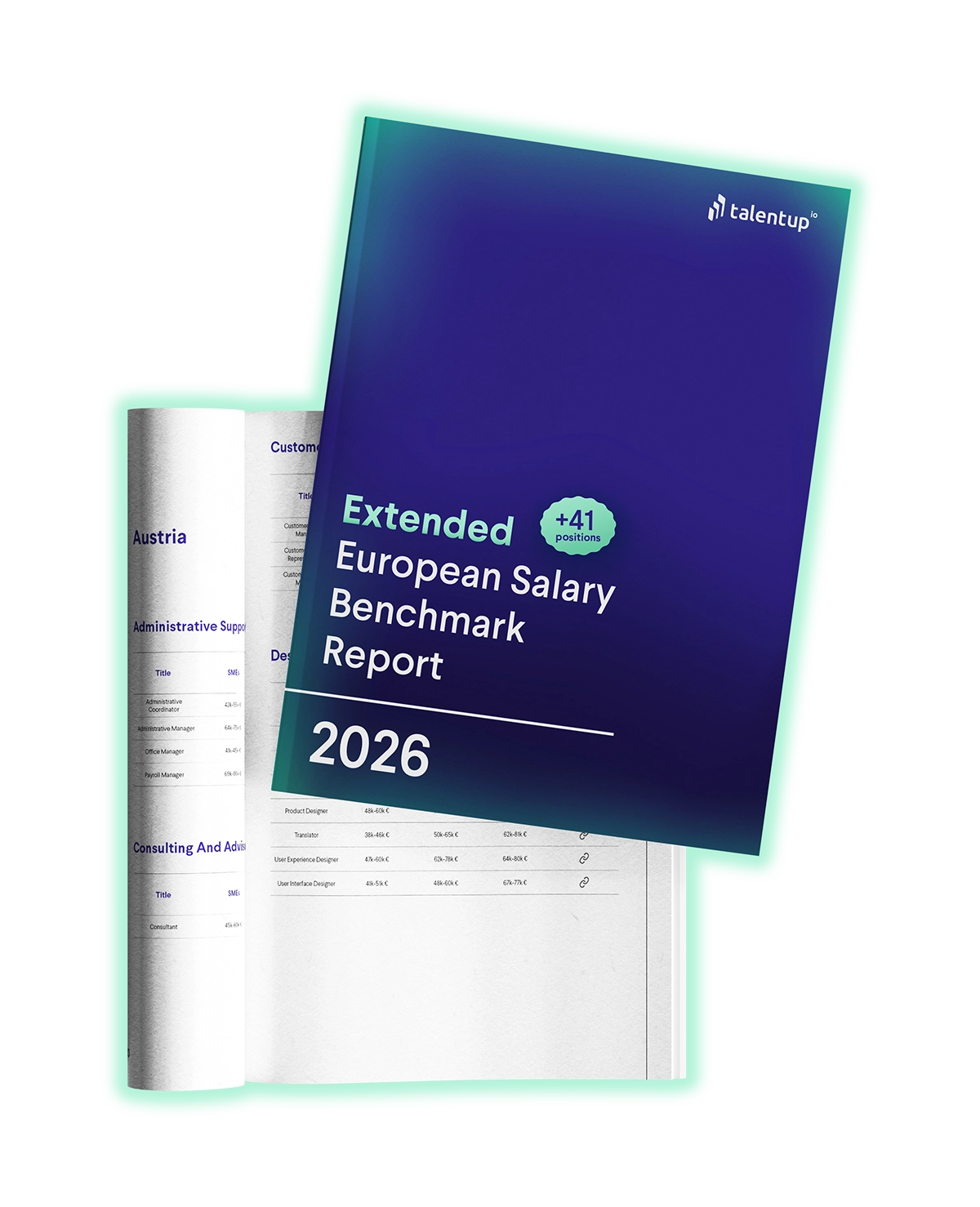
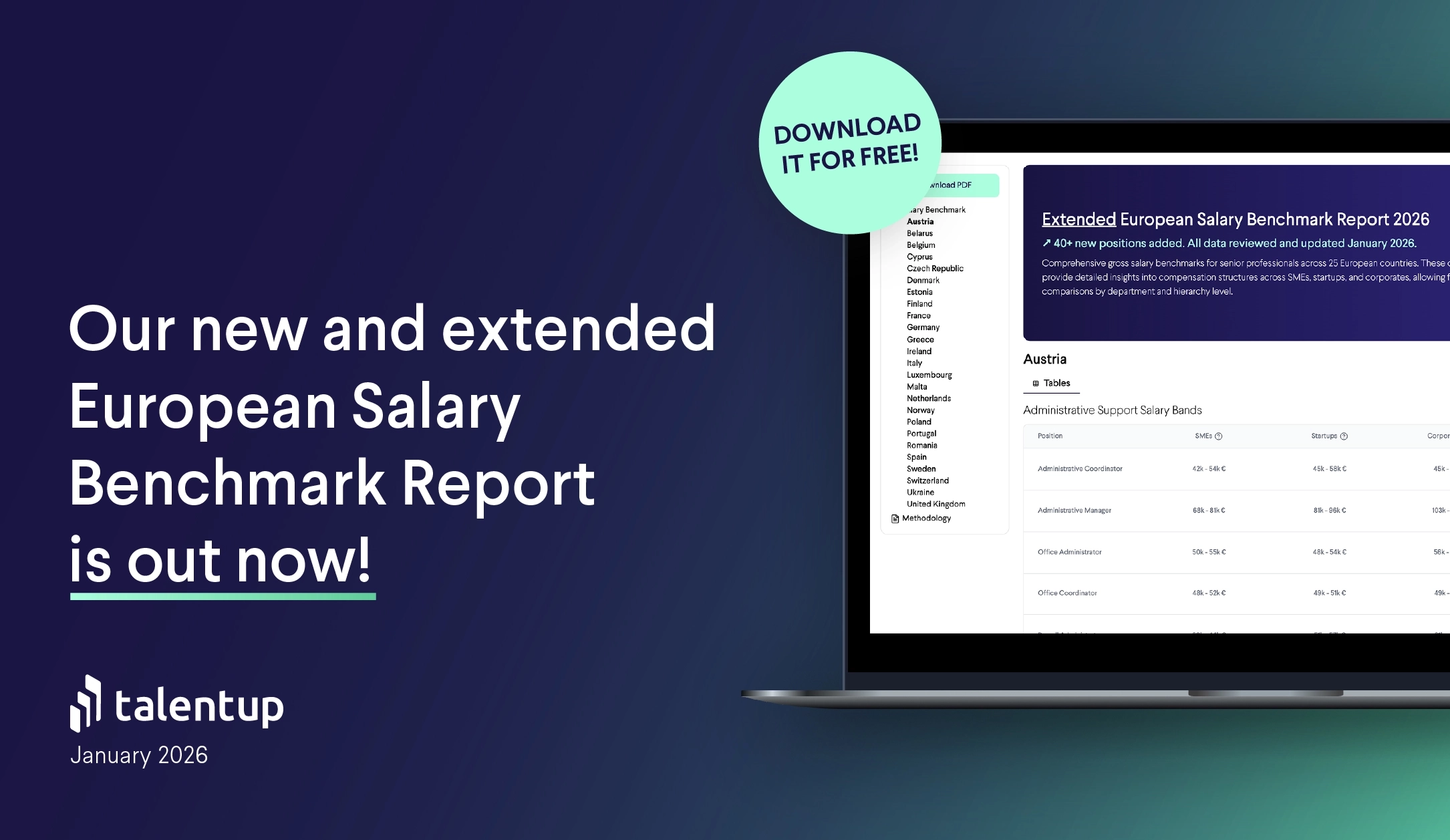
European Salary Benchmark Report

The Report includes gross salary for more than 75 top-tier professional job positions in 25 European countries.

Download now EU Report Mockup with download it for free overlay

Subscribe to our newsletter and stay updated

No spam, unsubscribe at any time