Cookie Settings

We use cookies to improve your experience and for marketing. Visit our Cookies Policy to learn more.

Compensation

Rethinking Compensation Strategy: Moving Beyond Intuition to Data-Driven Pay Models

Salary Finder: Your Global Pay Guide 🚀

Search Salaries for Any Role, Anywhere in the World with our Salary Benchmarking Platform

Compensation remains one of the most sensitive and strategically important areas within human resources. Despite its impact on talent acquisition, retention, and organizational performance, many companies continue to rely on informal, intuition-based approaches when determining employee pay. This reliance on subjective judgment introduces inconsistencies that can accumulate over time, resulting in inequitable salary structures, disengaged employees, and increased financial inefficiencies.

Within the disciplines of human resources and compensation and benefits, there is a growing recognition that pay strategy must evolve. Organizations that continue to anchor compensation decisions in historical precedent or managerial instinct risk falling behind in an increasingly competitive labor market. In contrast, companies that adopt structured, data-driven frameworks are better positioned to align pay with market realities, internal equity, and business objectives.

This article looks at the problems that come with using gut feelings for pay decisions, discusses the real effects of these methods, and describes the key parts of a modern pay strategy. It also highlights how tools such as the TalentUp Salary Benchmarking Platform support HR professionals in implementing more precise and scalable compensation models.

The Enduring Reliance on Intuition in Pay Decisions

Despite advancements in HR analytics and compensation technology, many organizations still default to informal decision-making processes when setting salaries. This tendency is particularly evident in organizations experiencing rapid growth or those without mature HR infrastructures.

Intuition-driven compensation typically manifests through several patterns. Hiring managers may base salary offers on candidate expectations rather than verified market data. Organizations may continue to rely on legacy pay structures that have not been recalibrated in years. Internal equity assessments are often conducted only when discrepancies are flagged, rather than through systematic analysis.

These practices may offer short-term flexibility, but they introduce variability that undermines consistency. Over time, compensation structures become fragmented, with significant disparities between roles, departments, and employee cohorts. This fragmentation complicates workforce planning and increases the likelihood of inequitable outcomes.

From a compensation and benefits perspective, the absence of structured frameworks limits the ability to enforce governance and maintain alignment with organizational strategy.

The Economic and Organizational Impact of Compensation Misalignment

Compensation misalignment is not always immediately visible, but its effects are cumulative and far-reaching. Employees continuously evaluate their compensation against both internal peers and external market benchmarks. When discrepancies arise, they influence employee perceptions of fairness, value, and opportunity.

One of the most significant outcomes of compensation misalignment is increased attrition. A substantial proportion of employees who leave organizations identify compensation as a contributing factor. Importantly, many of these employees do not formally communicate dissatisfaction prior to their departure. This creates a blind spot for organizations, which may underestimate the extent of compensation-related risk.

In addition to attrition, organizations face increased financial costs when compensation is managed reactively. These costs include counteroffers to retain employees, off-cycle salary adjustments, and inflated offers to attract external candidates. Research indicates that organizations without structured compensation frameworks can spend two to three times more on these reactive measures compared to those with proactive systems in place.

There are also intangible costs. Compensation inequities erode trust in leadership and HR processes. Employees who perceive unfairness in pay are more likely to disengage, which can impact productivity, collaboration, and overall organizational performance.

Compensation as a Strategic Business Function

The perception of compensation as a purely administrative or cost-focused function is becoming increasingly outdated. Leading organizations now treat compensation as a strategic lever that influences multiple dimensions of business performance.

From a talent perspective, competitive and equitable compensation is essential for attracting and retaining high-quality employees. From an operational perspective, structured compensation frameworks support workforce planning and resource allocation. From a cultural perspective, transparent and consistent pay practices reinforce organizational values and strengthen employee trust.

Compensation strategy also intersects with diversity, equity, and inclusion initiatives. Ensuring equitable pay across different demographic groups requires systematic analysis and ongoing monitoring. Without structured frameworks, organizations may inadvertently perpetuate disparities that expose them to reputational and regulatory risks.

For compensation and benefits professionals, this shift necessitates a more analytical and strategic approach. It requires integrating compensation data with broader HR metrics, such as turnover rates, performance outcomes, and engagement levels.

Core Components of a Modern Compensation Framework

A robust compensation strategy is built on a foundation of data, structure, and transparency. It provides clear guidelines for pay decisions while allowing for adaptability in response to changing market conditions.

Market-Based Salary Benchmarking

Reliable market data is the cornerstone of effective compensation management. Benchmarking involves comparing internal salaries with external market rates to ensure competitiveness. This process requires access to accurate, up-to-date data that reflects variations in role, industry, geography, and experience level.

Market benchmarking enables organizations to identify gaps between internal pay and market standards. It also supports informed decision-making when setting salary ranges, making offers, and adjusting compensation.

Structured Pay Bands

Pay bands establish defined salary ranges for specific roles or job levels. These ranges typically include minimum, midpoint, and maximum values, providing a framework for consistent pay decisions.

Well-designed pay bands facilitate internal equity by standardizing compensation across similar roles. They also support career progression by outlining clear pathways for salary growth. For HR professionals, pay bands serve as a governance mechanism that reduces variability and enhances accountability.

Regular Compensation Reviews

Compensation must be reviewed periodically to remain aligned with market conditions. Annual review cycles are standard practice, but organizations should also be prepared to conduct off-cycle reviews in response to significant changes in the labor market.

Regular reviews allow organizations to address discrepancies proactively. They also provide an opportunity to align compensation with performance outcomes and organizational priorities.

Transparent Communication

Transparency in compensation is increasingly important in modern workplaces. Employees expect clarity regarding how their pay is determined and how it compares to relevant benchmarks.

Effective communication involves explaining the rationale behind pay structures, providing visibility into salary ranges, and addressing employee questions consistently. While full disclosure may not be feasible in all contexts, increased transparency contributes to trust and engagement.

Implementation Challenges in Compensation Strategy

Transitioning to a structured compensation framework is not without challenges. Organizations must navigate several barriers to implementation.

Access to reliable data is a common constraint, particularly for specialized roles or emerging industries. Without accurate benchmarking data, it is difficult to establish competitive salary ranges.

Organizational resistance can also impede progress. Managers accustomed to discretionary decision-making may be hesitant to adopt standardized frameworks. Overcoming this resistance requires clear communication of the benefits and alignment with business objectives.

Resource limitations present another challenge. Developing and maintaining compensation frameworks requires investment in tools, expertise, and ongoing analysis. For smaller organizations, these requirements can be difficult to meet without external support.

Global organizations face additional complexity due to variations in labor markets, regulatory environments, and cost-of-living factors. Managing compensation across multiple geographies requires sophisticated systems and localized insights.

The Evolving Landscape of Compensation

Several trends are reshaping compensation practices and influencing how organizations approach pay strategy.

The rise of remote and hybrid work has introduced new considerations regarding geographic pay differentials. Organizations must determine whether to standardize pay across locations or adjust salaries based on local market conditions.

Skills-based compensation is gaining traction as organizations prioritize capabilities over job titles. This approach aligns pay with the specific skills and competencies that drive business value.

Regulatory developments are increasing the emphasis on pay transparency. In many regions, organizations are required to disclose salary ranges in job postings or provide greater visibility into pay structures.

Advancements in HR technology are enabling more sophisticated analysis of compensation data. These tools support real-time benchmarking, predictive analytics, and scenario modeling, allowing organizations to make more informed decisions.

TalentUp Salary Benchmarking Platform in Practice

The TalentUp Salary Benchmarking Platform represents a practical response to many of the challenges associated with compensation management. It is designed to support human resources and compensation and benefits professionals in transitioning from intuition-based practices to data-driven frameworks.

The platform aggregates and analyzes salary data across roles, industries, and geographies, providing organizations with a comprehensive view of market compensation trends. This enables HR teams to benchmark internal salaries accurately and identify discrepancies that may require adjustment.

One of the key advantages of TalentUp is its ability to provide real-time insights. Rather than relying on static reports, organizations can access dynamic data that reflects current market conditions. This is particularly valuable in fast-moving industries where salary expectations can shift rapidly.

The platform also supports detailed role segmentation. HR professionals can analyze compensation data based on job level, function, and location, enabling the creation of precise and tailored pay bands. This level of granularity enhances the accuracy of compensation frameworks and supports internal equity.

In addition to benchmarking, TalentUp functions as a decision-support tool. By centralizing compensation data, it allows HR teams to evaluate different scenarios and make informed choices. This reduces reliance on subjective judgment and improves consistency across the organization.

For growing organizations, scalability is a critical consideration. TalentUp is designed to adapt to organizational expansion, supporting both local and global compensation strategies. This ensures that compensation practices remain consistent even as the organization evolves.

FAQ: Compensation Strategy and Salary Benchmarking

What is the primary risk of relying on intuition for salary decisions?The primary risk is inconsistency. Intuition-based decisions often lead to uneven pay structures, where similar roles are compensated differently without clear justification. This increases the likelihood of inequity, attrition, and financial inefficiency.

Why do employees leave due to compensation without raising concerns?Employees may perceive limited opportunity for change or may prefer to explore external options rather than engage in internal negotiations. This makes compensation dissatisfaction difficult to detect without proactive analysis.

How does salary benchmarking improve retention?Benchmarking ensures that salaries are aligned with market expectations. When employees feel that their compensation is competitive and fair, they are less likely to seek opportunities elsewhere.

What are pay bands and why are they important?Pay bands are structured salary ranges assigned to roles or job levels. They provide consistency in pay decisions, support internal equity, and create clear pathways for salary progression.

How often should compensation be reviewed?At a minimum, compensation should be reviewed annually. However, organizations should also conduct reviews when significant market changes occur or when there are shifts in organizational priorities.

What role does transparency play in compensation strategy?Transparency builds trust. When employees understand how their pay is determined, they are more likely to perceive the system as fair, even if they do not have full visibility into all details.

What challenges do organizations face when implementing structured compensation frameworks?Common challenges include lack of reliable data, resistance from managers, limited resources, and the complexity of managing compensation across multiple geographies.

How does TalentUp Salary Benchmarking Platform support HR teams?TalentUp provides access to real-time market data, supports detailed role segmentation, and offers decision-support tools. This enables HR professionals to design and maintain structured, data-driven compensation frameworks.

Is salary benchmarking only relevant for large organizations?No. Organizations of all sizes benefit from benchmarking. Smaller companies, in particular, can avoid costly mistakes by aligning their compensation with market standards from an early stage.

How does compensation strategy impact overall business performance?Effective compensation strategy improves talent acquisition, reduces turnover, enhances employee engagement, and supports organizational stability. These factors collectively contribute to stronger business outcomes.

European Salary Benchmark Report

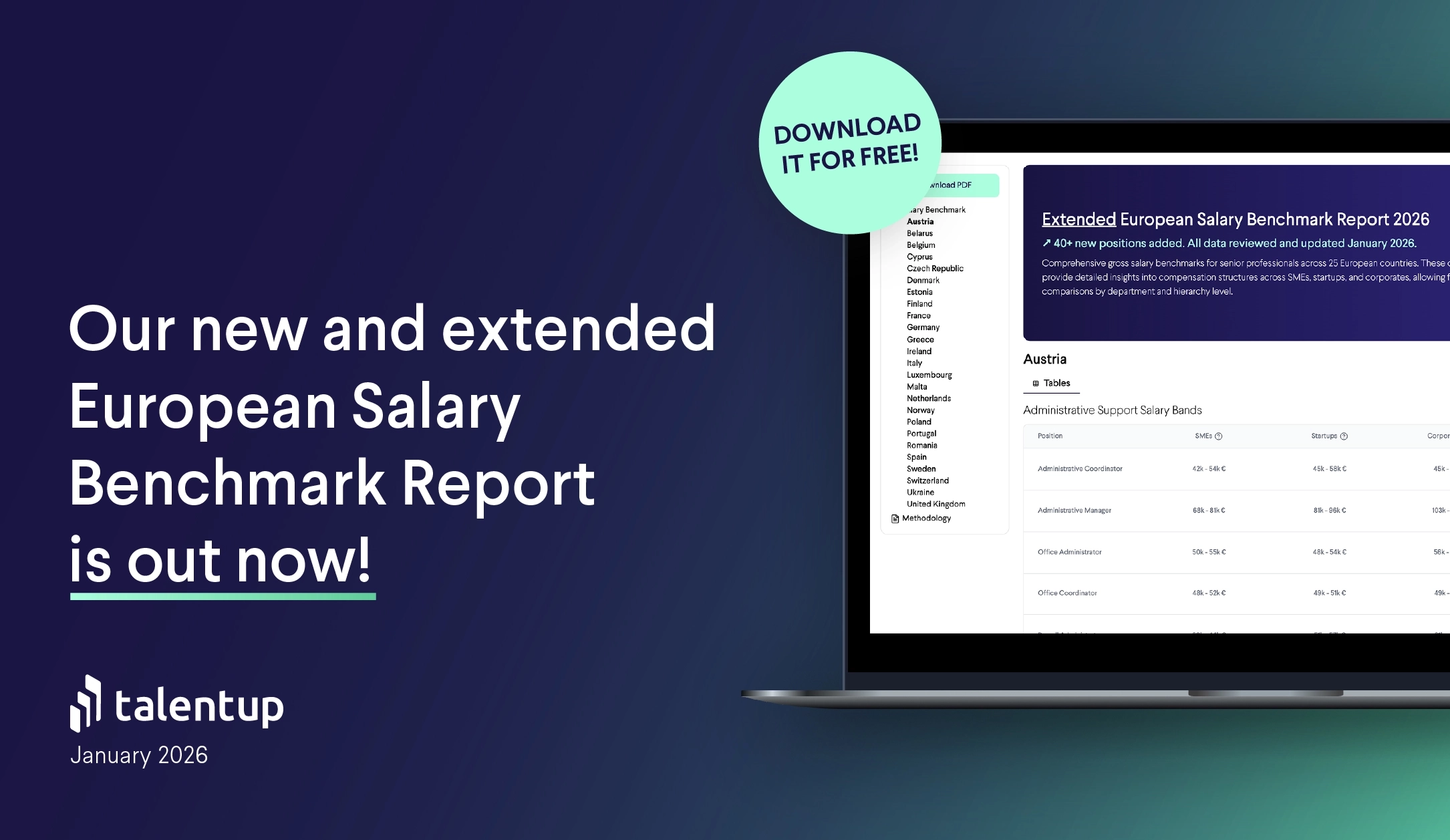
The Report includes gross salary for more than 75 top-tier professional job positions in 25 European countries.

Download now EU Report Mockup with download it for free overlay

Subscribe to our newsletter and stay updated

No spam, unsubscribe at any time