Cookie Settings

We use cookies to improve your experience and for marketing. Visit our Cookies Policy to learn more.

How AI Is Rewriting the HR Operating Model

Salary Finder: Your Global Pay Guide 🚀

Search Salaries for Any Role, Anywhere in the World with our Salary Benchmarking Platform

AI adoption in HR doubled in a single year. In 2025, 26% of HR functions had adopted AI in some form. By early 2026, the figure had risen to 43%. And 93% of recruiters say they plan to increase their use of AI further over the next twelve months.

This is not a slow-moving trend that People teams can afford to monitor from a distance. The organizations that are moving fastest on AI in HR are already reporting 31% faster hiring times, measurable improvements in the quality of hire, and workforce planning that can forecast skills gaps three years in advance. The gap between those organizations and those still running HR on spreadsheets and intuition is widening.

But the story is more complicated than the efficiency numbers suggest. AI in HR introduces real risks around bias, privacy, and governance that are beginning to attract regulatory attention on both sides of the Atlantic. And the shift to AI-augmented HR requires a fundamental rethink of what HR teams are actually for.

This article covers where AI is already changing HR, what People teams need to rethink, what the risks look like in practice, and what the new HR operating model is beginning to look like.

Where AI Is Already Doing Real Work

Recruiting and Screening

AI first meaningfully changed the recruiting function, and it is still where adoption is deepest. 67% of organizations now use some form of AI in their recruitment process. The use cases range from resume screening and candidate ranking to interview scheduling, outreach personalization, and predictive assessments of candidate fit.

The efficiency gains are real. AI-powered screening dramatically reduces the time HR teams spend on initial review, particularly for high-volume roles. But the more significant shift is qualitative: AI tools are changing which candidates get seen, not just how quickly they move through the process. That has important implications for bias and fairness, which we cover later.

Skills Identification and Matching

Skills-based hiring, the practice of evaluating candidates on demonstrable competencies rather than credentials and job titles, has been a stated priority for HR for several years. AI is finally making it operationally feasible at scale. Tools that extract and classify skills from CVs, job descriptions, and internal performance data allow HR teams to build dynamic skills inventories and match talent to opportunities in ways that static job architecture could never support.

68% of companies now use AI for predictive analytics in workforce planning and recruitment forecasting. The ability to map what skills exist in your current workforce, identify where gaps are emerging, and model what the organization will need 18 or 36 months from now is moving from aspirational to standard practice.

HR Service Delivery and Employee Experience

AI-powered HR service delivery: chatbots for policy questions, automated onboarding workflows, personalized learning recommendations, and real-time wellbeing signals from engagement data. 14% of organizations already use AI tools specifically in employee experience, a number that has grown rapidly as large language models have made conversational HR interfaces genuinely useful rather than frustrating.

The cumulative effect is a shift in what HR professionals actually spend their time on. Administrative and transactional work that previously occupied significant portions of HR capacity now automates. That creates space for more strategic work, but only if HR teams consciously redirect toward it rather than simply absorbing the freed time into existing processes.

Workforce Planning Has Become a Data Science Problem

Traditional workforce planning operated on annual cycles: headcount requests, budget approvals, and hiring plans. It was slow, backward-looking, and disconnected from real-time shifts in the business or the labor market.

AI-enabled workforce planning operates differently. It combines internal data (current headcount, skills inventory, attrition signals, performance data) with external data (labor market trends, compensation benchmarks, talent supply by location and discipline) to produce forecasts that are dynamic, granular, and actionable.

The practical implication for People teams is significant. Workforce planning is no longer primarily an exercise in counting heads and projecting last year’s growth rate forward. It is an exercise in understanding what capabilities the organization needs, what it currently has, where the gaps are, and how to close them through a combination of hiring, development, and restructuring.

This also changes the conversation HR has with the business. When People teams can show that a specific skills gap will materially affect product delivery in twelve months, or that attrition risk is concentrated in a particular function, they are operating as genuine strategic partners rather than administrators of headcount requests.

Reskilling Is HR’s New Core Responsibility

Four out of five workers will need to acquire new AI-related skills within the next twelve to eighteen months to remain competitive, according to PwC and World Economic Forum data. That is not a learning and development project. It is an organizational transformation that HR needs to lead.

The organizations that are handling this well are doing three things. They are being specific about which skills matter for which roles, rather than issuing blanket AI literacy mandates. They are building reskilling into the flow of work rather than treating it as a separate training track that competes with delivery timelines. And they are connecting skills development explicitly to career progression and compensation, so that employees have a concrete incentive to invest in their own development.

57% of HR teams at organizations where AI has been deployed report that AI implementation has led to frequent upskilling or reskilling opportunities for employees. But frequent opportunity is not the same as systematic capability building. The HR teams that are making the most progress are those that have moved from offering learning opportunities to actively managing skills development as a core workforce strategy.

The Risks HR Cannot Afford to Ignore

Bias in Automated Hiring

The efficiency gains of AI-powered screening come with a well-documented risk: bias. AI models trained on historical hiring data can learn and amplify the patterns embedded in that data, including patterns of exclusion. If your past hires skewed toward a particular profile, your AI screening tool may systematically disadvantage candidates who do not match that profile, even when those candidates would have been strong performers.

This is not a theoretical concern. New York City now requires annual, independent bias audits for any automated employment decision tool used in hiring or promotion. California, Colorado, Illinois, and Texas have all adopted new requirements around AI in hiring as of 2026. The EU AI Act classifies AI systems used in employment decisions as high-risk, with corresponding obligations around transparency, human oversight, and testing.

For People teams, this means that deploying AI in recruiting without governance is not just an ethical risk: it is a legal one.

Privacy and Data Governance

AI systems in HR depend on large amounts of employee data: performance records, engagement scores, skills assessments, communication patterns, and in some cases biometric data from video interviews. In the EU, this data is subject to GDPR, which requires a lawful basis for processing, clear purpose limitation, and robust data retention policies.

The question HR teams need to answer before deploying any AI tool is not just “does this work?” but “do we have the right to use this data in this way, and can we explain to employees what we are doing with it?” Trust in AI-augmented HR depends as much on how data is handled as on how accurate the outputs are.

The Governance Gap

HR professionals reported that legal and compliance functions primarily lead AI governance in 37% of organizations. HR and IT collaborate on AI guidelines in around two thirds of cases. But a clear, organization-wide framework for how AI decisions in HR are made, reviewed, and contested remains the exception rather than the rule.

The governance gap matters because AI in HR produces decisions that directly affect people’s careers and livelihoods. The accountability for those decisions cannot be diffused into an algorithm. HR teams need to own the outcomes of AI-assisted processes, which means they need to understand how the tools they are using actually work, what their limitations are, and how to override them when necessary.

What the New HR Operating Model Looks Like

The HR operating model that emerges from AI adoption is not one where HR does the same things faster. It is one where the definition of HR work changes.

Transactional and administrative work moves to automation. Skills management becomes a continuous, data-driven discipline rather than an annual exercise. Workforce planning operates in near real-time and informs business strategy. HR service delivery becomes largely self-serve, with human HR professionals handling complexity and exceptions rather than routine queries. And governance of AI tools and the data that underpins them becomes a core HR competency.

What remains irreducibly human is the judgment-intensive work: the decisions that require understanding context, weighing competing interests, and building trust. The redundancy conversation. The performance challenge. The organizational design decision with no obviously correct answer. AI can inform these decisions, but it cannot make them.

For People teams, the shift requires investing in data literacy, building governance frameworks before they are legally required, and being deliberate about which tasks are genuinely better handled by AI and which ones lose something essential when they are automated.

Compensation is a useful test case. AI can accelerate salary benchmarking, flag pay equity issues, and model the cost of closing gaps. But the decision about how to communicate a pay range, how to handle an employee who discovers they are below the midpoint, and how to build a compensation philosophy that the organization will actually stand behind: those remain human responsibilities. The value of real-time salary data is that it gives HR teams the factual foundation to have those conversations with confidence rather than uncertainty.

TalentUp’s salary benchmarking platform is built for exactly this moment. As HR operating models become more data-driven and AI-assisted, having live market benchmarks across 700+ roles and 300+ locations means compensation decisions are grounded in current reality, not last year’s survey. That foundation matters more, not less, as the pace of change in skills, roles, and labor markets accelerates.

Want to see how real-time salary data fits into your AI-enabled HR strategy? Request a demo and see TalentUp’s benchmarking platform in action.

Sources and data references: SHRM State of AI in HR 2026, Second Talent AI Recruitment Statistics 2026, Novoresume AI Hiring Statistics, MITRMEDIA AI in HR 2026, Digital Applied AI Upskilling 2026, SHRM AI Regulations 2026, HR Defense AI in Hiring Legal Developments 2026

Global Salary Benchmark Excel

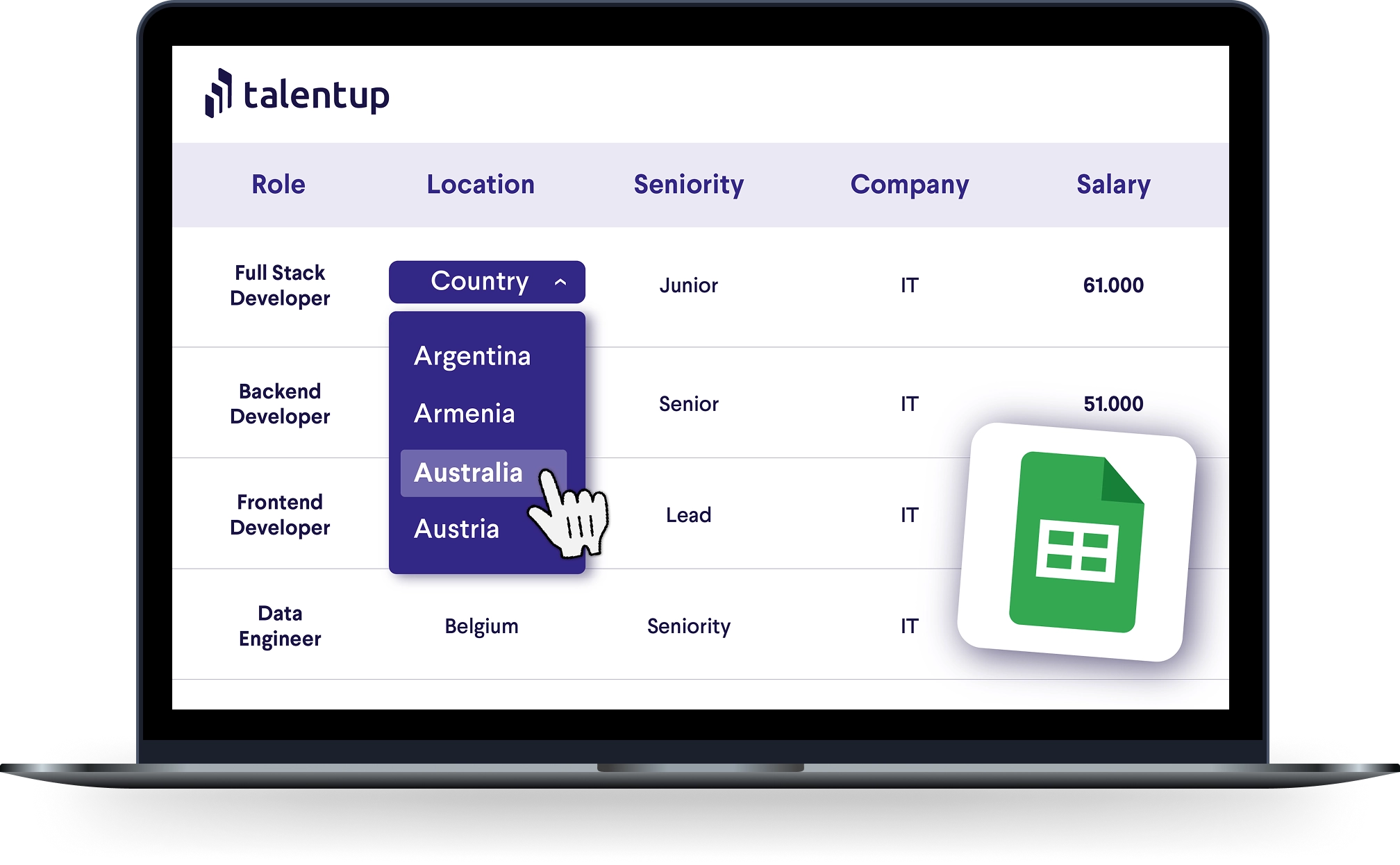
This free Excel offers salary information covering 475 job roles across 75 countries, comparing salary ranges internationally.

Download now Excel Salary Benchmarking Mockup with download it for free overlay

Subscribe to our newsletter and stay updated

No spam, unsubscribe at any time