Understanding the tax and payroll landscape in Spain is essential for any employer, HR professional, or compensation specialist managing a workforce there. Tax rates, social security contribution structures, and payroll administration requirements directly affect total employment costs, net take-home pay, and the competitiveness of salary packages. This article provides a structured overview of Spain’s personal income tax system, employer and employee social security contributions, and key payroll obligations. It also explains how the TalentUp Salary Platform supports salary benchmarking for HR teams operating in Spain and across European markets.
For HR and compensation teams, understanding the difference between gross salary and total employment cost is fundamental to effective workforce budgeting. In Spain, as in every country, the employer’s outlay significantly exceeds the gross figure on the employee’s payslip. Getting this calculation right is the starting point for any compensation planning exercise. Average salary in Spain: factors, trends and expectations is an area where accurate local data makes a material difference, and European pay transparency legislation: new rules approved provides important context for the regulatory environment within which Spain’s pay practices sit.
Overview of the tax system in Spain
Spain operates a progressive personal income tax (IRPF) with rates from 19% to 47%. The tax brackets are structured as follows: 19% (up to EUR 12,450), 24% (EUR 12,450–20,200), 30% (EUR 20,200–35,200), 37% (EUR 35,200–60,000), 45% (EUR 60,000–300,000), and 47% above EUR 300,000. The standard VAT rate is 21% and the corporate income tax rate is 25%. These rates create the fiscal framework within which employers and employees operate.
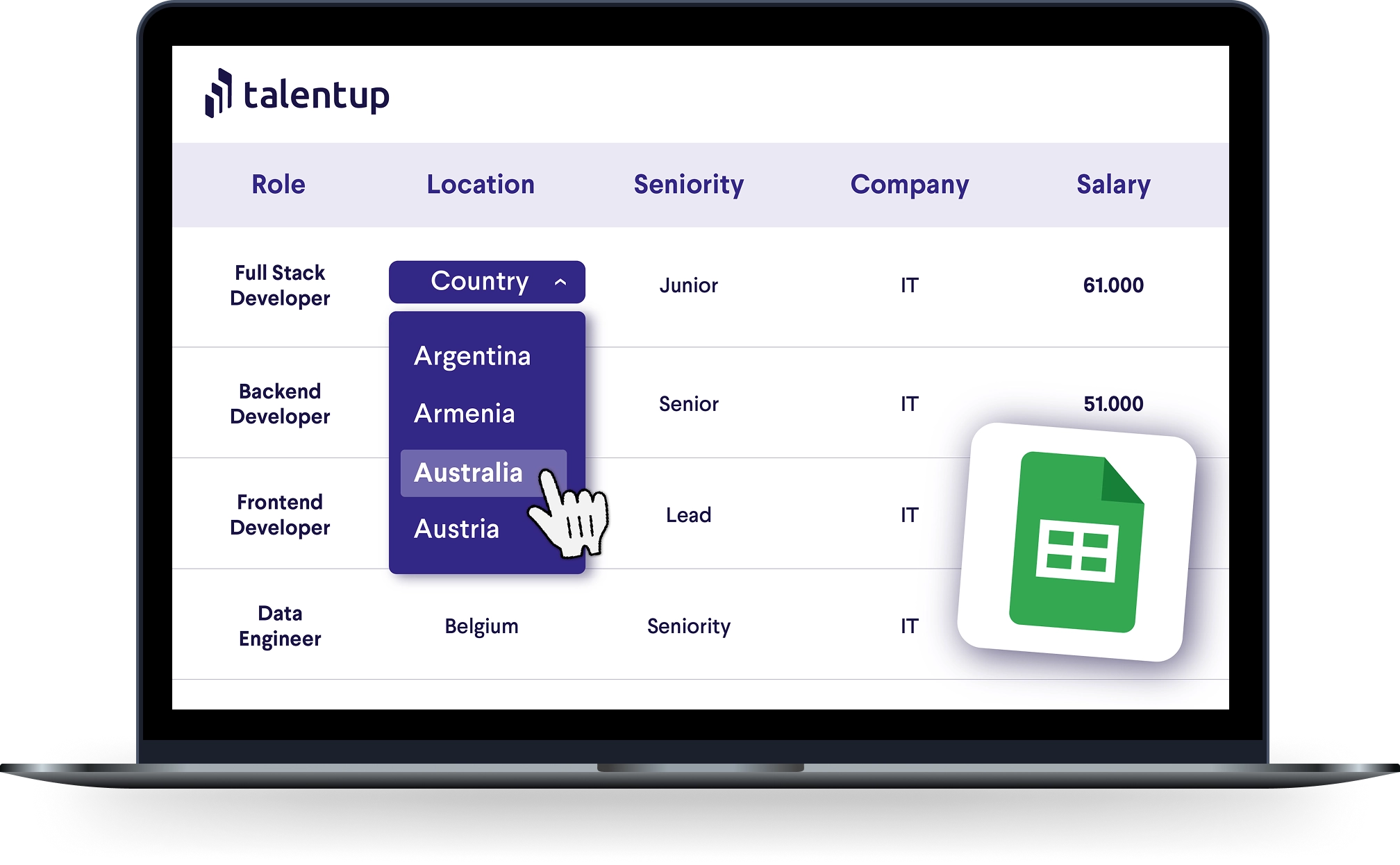
For employers, the personal income tax rate matters primarily because it influences what employees need to earn gross in order to achieve a given net salary. When benchmarking compensation in Spain, understanding the net effect of the tax system helps explain why gross salary expectations differ from those in neighbouring countries with different tax profiles. The TalentUp Salary Platform provides gross salary benchmarks by role and location, giving compensation teams the reference point they need to position packages correctly.
Employer social security contributions in Spain
Employers in Spain are required to contribute approximately 29.9% (including general contingencies, unemployment, FOGASA, and vocational training) in social security and related charges on top of gross salary. These contributions fund the statutory social protection system and represent a significant element of total employment cost that must be factored into any headcount budget.
Spanish social security contributions are split between employer and employee. The employee pays approximately 6.35% of gross salary, covering general contingencies (4.7%), unemployment (1.55%), and vocational training (0.1%). The employer bears a much larger share: approximately 23.6% for general contingencies, 5.5% for unemployment, 0.2% for FOGASA (wage guarantee fund), and 0.6% for vocational training. These contributions are subject to a monthly maximum contribution base that is updated annually.
Employee social security contributions in Spain
Employees in Spain contribute approximately 6.35% of their gross salary toward social insurance. These deductions are made at source by the employer and reduce the employee’s taxable income in some cases. Understanding the employee contribution rate is important when communicating total compensation to candidates, as it determines the gap between gross and net pay before income tax is applied.
The combination of income tax and employee social security contributions defines the effective take-home rate for employees in Spain. For employers designing compensation packages, particularly for senior roles where candidates compare offers across multiple countries, being able to translate gross salary into approximate net pay is a practical necessity. Candidates increasingly expect transparent communication about what they will actually receive.
Payroll administration in Spain
Spain operates a monthly PAYE withholding system (retención a cuenta del IRPF). Employers must file monthly or quarterly withholding declarations (Modelo 111) and an annual summary (Modelo 190). Social security contributions are reported and paid monthly through the Sistema RED (Remisión Electrónica de Datos). Employers with more than 50 employees must also register monthly with the Social Security General Treasury (TGSS). Like Portugal, Spain requires 14 monthly salary payments in most collective agreements: the holiday pay (paga de vacaciones) and the Christmas bonus (paga de navidad).
Payroll errors in Spain can result in penalties, interest charges, and compliance risk. For employers new to Spain, working with a local payroll provider or employer of record (EOR) during the initial setup phase reduces the risk of procedural errors. Established employers should ensure their payroll system is updated to reflect legislative changes — tax thresholds, social security rates, and minimum wage levels are all reviewed periodically and changes must be applied in the correct payroll period.
Notable features of Spain’s payroll and tax system
Spain’s autonomous communities (regions) have the authority to modify the lower half of the IRPF scale, which means effective tax rates can differ between Madrid, Catalonia, the Basque Country, and other regions. The Basque Country and Navarra operate under a distinct fiscal arrangement (foral regime) with their own income tax rules.
Employers in Spain are subject to the EU Pay Transparency Directive, which requires organisations to publish salary ranges in job postings, provide pay information to employees on request, and report gender pay gaps annually. This directive adds a compliance layer to payroll and compensation management that requires employers to have structured, market-referenced salary bands in place before the implementation deadline. Having accurate benchmarking data is a prerequisite for meeting these requirements credibly. The TalentUp platform provides the role-specific, percentile-based data needed to build and justify pay ranges that withstand transparency scrutiny.

Total employment cost in Spain
When budgeting for a new hire in Spain, the gross salary figure on the offer letter is only part of the picture. The employer must add social security contributions (approximately 29.9% (including general contingencies, unemployment, FOGASA, and vocational training)) to arrive at the total employment cost. For example, if an employer offers a gross annual salary of EUR 50,000, the actual payroll cost including employer contributions will be substantially higher. This total employer cost is what should be benchmarked against budget allocations and headcount models, not the gross salary alone.
On the employee side, the net take-home figure after income tax and employee social security contributions (approximately 6.35%) determines what the employee actually receives. Candidates and existing employees increasingly compare net pay when evaluating offers, particularly when comparing opportunities across countries with different tax burdens. HR teams in Spain who can clearly communicate the gross-to-net conversion — and who benchmark gross salaries to a consistent market reference — are better positioned to attract and retain the professionals they need.
Sector and company size remain the two most powerful determinants of where individual salaries sit within any market range in Spain. Technology companies, financial services firms, and multinationals typically pay above the market median for comparable roles, while public sector and domestic mid-market employers often pay below. Understanding which segment of the market you compete in is the first step toward building a salary benchmarking framework that is relevant to your actual hiring context.
Using TalentUp for salary benchmarking in Spain
Salary benchmarking in Spain requires data that is current, role-specific, and relevant to the local employer market. General national statistics provide a broad average but rarely offer the granularity compensation teams need when setting pay for a specific role at a specific seniority level. The TalentUp Salary Platform provides median salary data by role, location, industry, and company size, updated continuously from a live dataset rather than relying on annual survey publications that are often several months out of date.
For HR teams managing compensation in Spain, TalentUp benchmarks allow you to position roles at a defined market percentile (for example, the 50th or 75th percentile), build salary bands with upper and lower bounds grounded in data, and document the methodology behind pay decisions. This is increasingly important as employees and candidates expect transparency around how pay ranges are set. The platform covers multiple European markets, enabling consistent benchmarking methodology whether your team is benchmarking roles in Spain or in a neighbouring European market.
Key considerations for international employers in Spain
Employers establishing or scaling operations in Spain should pay particular attention to the compliance calendar: payroll filing deadlines, social security payment dates, and minimum wage update cycles are all fixed obligations that carry penalties if missed. Statutory leave entitlements, mandatory bonus or severance requirements, and any sector-specific collective agreement obligations should be identified early in the employment relationship, as they affect both payroll cost projections and employee relations. Engaging a local payroll or HR advisory firm during the setup phase is advisable for organisations entering Spain for the first time.
For established employers in Spain, an annual compensation review that combines external market benchmarking with internal equity analysis is best practice. The external benchmark from the TalentUp Salary Platform identifies where your pay ranges sit relative to the market, while the internal equity review ensures that similar roles and comparable experience levels are paid consistently within your organisation. Together, these two perspectives form the basis of a defensible and competitive pay structure.
Conclusion
The Spain tax and payroll system has a distinctive structure that affects both total employment cost for employers and net take-home pay for employees. Getting the details right — income tax withholding, social security contributions, payroll filing deadlines, and statutory pay requirements — is fundamental to compliant and efficient payroll management. For compensation professionals, layering accurate salary benchmark data on top of this tax understanding allows for informed pay decisions that are competitive in the Spain market and defensible to employees, candidates, and increasingly to regulators. Access up-to-date salary data for Spain and other European markets through the TalentUp Salary Platform.
Sources
- Agencia Tributaria (AEAT), Impuesto sobre la Renta de las Personas Físicas (IRPF)
- Ministerio de Inclusión, Seguridad Social y Migraciones, Cotizaciones a la Seguridad Social — España
- Eurostat, Earnings and Labour Costs Statistics across Europe
- OECD, Taxing Wages — OECD Country Comparisons
- TalentUp Salary Platform, Salary benchmarking and total employment cost data for Spain